Marriage naturally brings two different people together, which means disagreements are sometimes unavoidable. Even couples who love each other deeply can have different opinions about money, household responsibilities, family, communication, parenting, or personal boundaries.
What matters is not whether a married couple ever argues. What matters is how those disagreements are handled.
I have found that healthy conflict resolution is less about proving who is right and more about protecting the relationship while working through the problem. When couples learn how to communicate during difficult moments, disagreements can become opportunities to understand each other better rather than reasons to create emotional distance.
Healthy Ways to Resolve Conflict in Marriage: Why Conflict Resolution Matters
Conflict can become damaging when couples allow frustration, resentment, or pride to control the conversation. A small disagreement can quickly become a much larger argument when one partner brings up old mistakes, uses hurtful words, or refuses to listen.
Healthy conflict resolution creates a different pattern. Instead of treating a disagreement as a battle, both partners can approach it as a problem that needs to be solved together.
For example, imagine that one spouse feels that the other is not helping enough with household responsibilities. Saying, “You never help me with anything,” is likely to make the other person defensive. A healthier approach might be, “I have been feeling overwhelmed with the household responsibilities, and I need more help.”
The issue remains the same, but the conversation becomes less attacking.
This is one of the most important principles I encourage couples to understand: the goal of a disagreement should not be to defeat your spouse. The goal should be to understand the problem and find a solution that protects the marriage.
Healthy conflict resolution can also strengthen emotional intimacy. When spouses know they can discuss difficult subjects without being insulted, dismissed, or threatened, they are more likely to communicate honestly.
That sense of emotional safety matters because unresolved disagreements rarely disappear on their own. When problems are repeatedly ignored, resentment can quietly build until even minor issues trigger major arguments.
Learning how to resolve conflict in marriage does not mean that every disagreement will end with both spouses completely satisfied. Sometimes compromise is necessary. Sometimes one partner needs to acknowledge that they were wrong. In other situations, both people may need to adjust their expectations.
The important thing is that the couple leaves the conversation with greater understanding rather than deeper resentment.
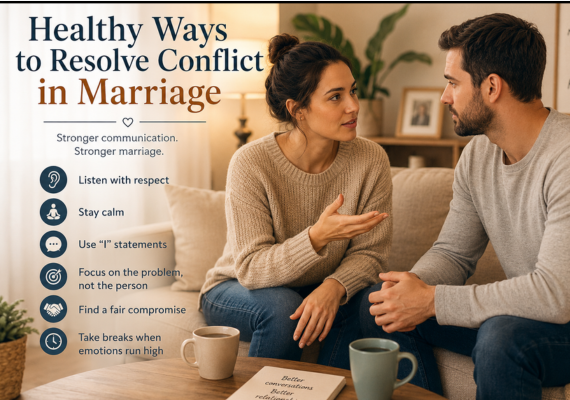
Stay Calm and Avoid Reacting in Anger
One of the healthiest ways to resolve conflict in marriage is to learn when to slow down. Anger can make even reasonable people communicate in ways they later regret.
When emotions become intense, it becomes harder to listen carefully, understand your spouse’s perspective, or choose your words wisely. Instead, the conversation can turn into a competition where each person is trying to defend themselves.
I strongly believe that taking a moment to calm down is not the same as avoiding the problem. In many situations, a short break can prevent an argument from becoming unnecessarily hurtful.
For example, if a disagreement about finances suddenly turns into shouting, continuing the conversation simply because the issue needs to be solved immediately may make things worse. One spouse could say, “I am too upset to have this conversation properly right now. I want us to continue talking about it, but I need a little time to calm down.”
That statement is very different from walking away and refusing to discuss the issue again.
The key is to make the break temporary and intentional. If you need time to cool down, communicate that clearly and return to the conversation when you are emotionally prepared.
During that time, avoid using the break to build an even stronger case against your spouse. The purpose is not to rehearse every reason you believe you are right. The purpose is to regain enough emotional control to have a productive conversation.
A calm conversation also makes it easier to recognize what the disagreement is actually about. Sometimes anger focuses attention on the immediate complaint while hiding the deeper issue.
A spouse may complain about a partner arriving home late, for example, when the deeper concern is feeling unimportant or disconnected. Recognizing that underlying emotion can completely change the conversation.
Instead of arguing about the exact time someone arrived home, the couple may discover that they need to discuss communication, expectations, and quality time together.
Listen to Your Spouse Without Interrupting
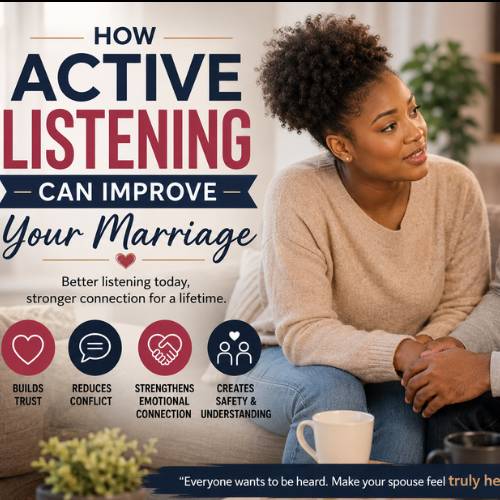
Listening is one of the most overlooked parts of healthy conflict resolution in marriage. Many couples believe they are listening when they are actually preparing their response.
There is a major difference between hearing your spouse and genuinely trying to understand what your spouse is saying.
During an argument, it can be tempting to interrupt because you believe your partner is misunderstanding you. You may already be thinking about the evidence you want to provide or the mistake you want to point out.
However, interrupting often sends a message that your spouse’s feelings are less important than your response.
Instead, allow your partner to explain their perspective before responding. This does not mean you have to agree with everything they say. It simply means that you are giving them enough space to communicate.
A useful approach is to repeat the main point in your own words before responding.
For example, you might say, “So you’re saying that when I make plans without telling you, you feel like your time is not being respected. Is that what you mean?”
This simple habit can prevent many misunderstandings.
It also gives your spouse an opportunity to correct you if you misunderstood something. That is far more productive than immediately defending yourself.
Active listening also involves paying attention to emotions. Sometimes the words are only part of the message. A spouse may say, “You are always busy,” but the deeper message may be, “I miss spending time with you.”
When couples learn to listen for the emotion behind the complaint, conversations can become much more meaningful.
I also recommend putting distractions aside during serious conversations. Constantly checking a phone, watching television, or walking around while your spouse is trying to explain something can make them feel ignored.
Giving your full attention communicates something powerful: this relationship and this conversation matter to me.

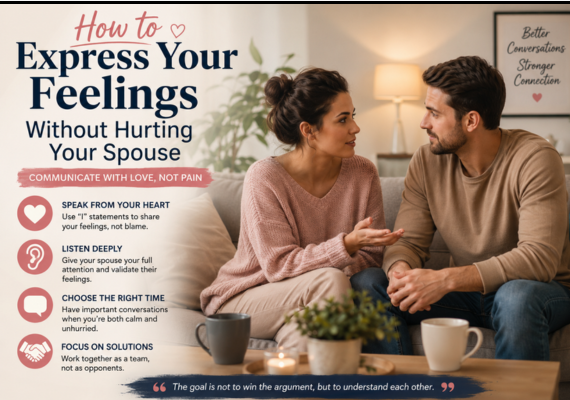
Use “I” Statements Instead of Blame
The way a problem is presented can determine whether a conversation becomes constructive or confrontational.
Statements beginning with “you always” or “you never” often sound like accusations. Even when the underlying concern is legitimate, blaming language can make a spouse immediately focus on defending themselves.
Using “I” statements creates more room for honest communication.
Instead of saying, “You never listen to me,” try saying, “I feel ignored when I am speaking and the conversation is interrupted.”
Instead of saying, “You don’t care about our finances,” consider saying, “I feel anxious when we make large purchases without discussing them first.”
The second approach does not hide the problem. It simply explains the personal impact of the behavior without immediately attacking the other person’s character.
This distinction is especially important because there is a difference between criticizing a behavior and criticizing a person.
A couple can discuss a specific action without turning that action into a judgment about someone’s entire personality.
For example, “I was hurt when you canceled our plans without telling me” is much healthier than “You are selfish.”
The first statement identifies a behavior and its emotional effect. The second attacks the person’s character, which can make productive communication much more difficult.
When couples consistently use respectful language, even difficult conversations can become easier to manage. The goal is not to avoid expressing disappointment. The goal is to express it in a way that gives both partners an opportunity to respond honestly.
Most importantly, healthy communication does not require pretending that everything is fine. It requires being honest without being unnecessarily hurtful.
Focus on the Problem, Not the Person
One of the most effective healthy ways to resolve conflict in marriage is to separate the problem from the person. When disagreements become personal, couples often stop trying to solve the original issue and start attacking each other’s character.
A disagreement about household chores can quickly become, “You are lazy.” A discussion about spending can turn into, “You are irresponsible.” Once the conversation reaches that point, solving the original problem becomes much more difficult.
I recommend keeping the conversation focused on the specific behavior or situation that needs attention. Ask yourself, “What exactly are we trying to solve?” That question can help prevent a disagreement from expanding into a list of unrelated complaints.
For example, if one spouse repeatedly forgets to communicate changes to their schedule, the conversation should focus on communication rather than bringing up every mistake from the past.
A healthier statement might be, “When your plans change and I don’t hear from you, I feel frustrated because I don’t know what to expect. Can we agree on a better way to communicate changes?”
This approach identifies the problem while still showing respect for the person.
It is also important to avoid keeping a mental record of every mistake your spouse has ever made. Bringing up unrelated issues during every argument can make your partner feel as though nothing they do is ever good enough.
If an old issue genuinely needs to be discussed, give it its own conversation rather than using it as ammunition during a completely different disagreement.
Find a Compromise That Works for Both Partners
Marriage often requires compromise because two people will not always have identical preferences, expectations, or priorities.
Compromise does not mean that one spouse always gives in while the other gets their way. That creates an unhealthy pattern rather than a healthy marriage. Good compromise means both partners are willing to make reasonable adjustments to reach an outcome they can accept.
Consider a couple who disagrees about how to spend their weekends. One spouse wants to spend more time with friends, while the other prefers quiet time together at home.
Instead of deciding that one person’s preference matters more, they could create a balance. They might spend one weekend afternoon with friends and reserve another part of the weekend for quality time together.
The exact solution will depend on the couple, but the principle remains the same: look for an arrangement that respects both people’s needs.
Compromise becomes easier when couples stop asking, “How can I get my way?” and start asking, “What solution would be fair to both of us?”
That small change in perspective can completely alter the tone of a disagreement.
However, compromise should not be used to justify harmful behavior. Healthy marriage conflict resolution requires mutual respect. A spouse should never be pressured into accepting intimidation, threats, humiliation, manipulation, or other forms of abuse simply to keep the peace.
In ordinary disagreements, though, flexibility can be one of the strongest tools a couple has.
Sometimes the best solution will not be exactly what either person originally wanted. That is perfectly normal. The success of conflict resolution should be measured by whether the couple found a respectful and workable solution, not whether one person completely won the argument.
Know When to Take a Short Break
There are moments when continuing an argument is unlikely to produce anything useful. Voices may be getting louder, emotions may be escalating, and both spouses may be repeating the same points without actually listening.
Knowing when to pause can prevent unnecessary damage.
Taking a break does not mean abandoning the conversation. It means recognizing that the current emotional state is making productive communication difficult.
A spouse might say, “I care about resolving this, but I don’t think I can discuss it calmly right now. Can we take some time and talk again this evening?”
That gives the other partner reassurance that the issue has not been ignored.
The important part is following through. A temporary pause becomes unhealthy when it is used as a way to punish, manipulate, or permanently avoid difficult conversations.
During a break, give yourself time to settle emotionally rather than planning your next attack. Think about what you actually want your spouse to understand.
Ask yourself questions such as:
- What am I really upset about?
- What do I need from my spouse?
- Did I misunderstand something?
- Is there anything I could have handled differently?
- What solution would realistically work for both of us?
These questions can help turn an emotional reaction into a productive conversation.
When both partners return to the discussion with calmer emotions, they have a much better chance of hearing each other and reaching an agreement.
How to Prevent the Same Marriage Conflicts From Repeating
Resolving an argument is important, but preventing the same conflict from happening repeatedly is even better.
If a couple argues about the same subject every few weeks, simply apologizing after each disagreement may not solve the underlying problem. The couple may need to identify the pattern and create a practical solution.
For example, if disagreements repeatedly happen because one spouse feels responsible for most household tasks, the answer may not be another apology. The couple may need to create a clearer division of responsibilities.
Likewise, if money repeatedly causes arguments, discussing individual spending habits may not be enough. A couple may benefit from agreeing on a shared budget, spending limits, savings goals, and rules for major purchases.
The goal is to turn repeated conflict into a system that reduces future misunderstandings.
Regular relationship check-ins can also help. Instead of waiting until frustration becomes an argument, couples can occasionally discuss what is working, what is becoming difficult, and what needs to change.
These conversations do not have to be dramatic. Even a simple question such as, “Is there anything you feel we need to work on as a couple?” can open the door to meaningful communication.
Small problems are generally easier to address before they become large resentments.
When Couples Should Consider Professional Help
Not every marriage conflict can be solved through better communication alone. Some couples become trapped in patterns of repeated arguments, emotional distance, resentment, or communication breakdown.
When attempts to resolve the same problems repeatedly fail, professional support may be worth considering.
A qualified marriage or couples counselor can provide a neutral environment where both partners have an opportunity to express themselves and learn healthier communication patterns.
Seeking help does not automatically mean that a marriage is failing. In many cases, it means that the couple recognizes that the relationship is important enough to receive additional support.
Professional help can be especially valuable when couples cannot discuss important issues without the conversation becoming hostile or when the same unresolved conflict continues to damage emotional connection.
However, situations involving abuse, threats, intimidation, or fear require a different approach from ordinary marital disagreements. Personal safety should always take priority over trying to resolve a conflict as a couple.
Final Thoughts on Healthy Conflict Resolution in Marriage
Conflict is not automatically a sign of an unhealthy marriage. What matters is how couples respond when they disagree.
Healthy marriage conflict resolution requires patience, honest communication, active listening, emotional control, respect, and a willingness to compromise. It also requires both spouses to recognize that protecting the relationship is more important than winning an argument.
I believe one of the most valuable changes a couple can make is to stop viewing conflict as one spouse versus the other. The healthier mindset is that both partners are facing a problem together.
When couples learn to stay calm, listen carefully, speak without blame, focus on specific problems, compromise fairly, and return to difficult conversations when emotions have settled, disagreements can become opportunities for growth.
A strong marriage is not one without conflict. It is one where both people continue learning how to handle conflict with respect, maturity, and genuine care for each other.

Daniel Master is a relationship and marriage writer passionate about helping readers build healthier relationships, stronger marriages, and more meaningful connections. Through practical advice, thoughtful insights, and fresh perspectives on weddings and modern relationships, Daniel creates easy-to-understand content designed to help readers make confident decisions in love and life.