Every healthy marriage depends on honest communication. Yet, one of the biggest struggles many couples face is learning how to express your feelings without hurting your spouse. I have seen many marriages suffer not because love disappeared, but because emotions were communicated in ways that created distance instead of connection.
Many people either bottle up their emotions until they explode or say everything on their mind without considering how their words affect their partner. Neither approach leads to a healthy marriage. Your spouse deserves honesty, but they also deserve kindness, respect, and understanding.
Expressing your feelings is not about avoiding difficult conversations. Instead, it is about choosing words that communicate your emotions while protecting the relationship. When you learn this skill, disagreements become opportunities to understand each other instead of battles that leave emotional scars.
In this guide, I will explain practical, proven ways to communicate your emotions with confidence while maintaining respect for your spouse. Whether you are dealing with disappointment, frustration, loneliness, or unmet expectations, these strategies can help you build a stronger, more emotionally connected marriage.
Why Expressing Your Feelings Matters in Marriage
Many couples assume their spouse should automatically know how they feel. Unfortunately, that expectation often leads to misunderstandings. No matter how long you have been married, your partner cannot read your mind.
Healthy marriages thrive because both people intentionally communicate what they are experiencing emotionally. When you openly express your feelings, you create opportunities for understanding, empathy, and teamwork.
Keeping emotions hidden might seem easier in the moment, but over time, unspoken feelings become resentment. Small disappointments accumulate, and eventually even minor disagreements can trigger major arguments because deeper issues have never been addressed.
On the other hand, expressing your feelings respectfully allows your spouse to understand your perspective before problems become overwhelming. Instead of guessing what is wrong, they have the opportunity to support you, apologize if necessary, or work together toward a solution.
For example, imagine feeling ignored because your spouse spends every evening on their phone. Rather than saying, “You never care about me anymore,” you could say:
“I’ve been feeling lonely lately because I miss spending quality time together in the evenings. I’d really love it if we could set aside some time just for us.”
Notice the difference. The first statement attacks your spouse’s character. The second shares your feelings honestly while inviting a positive response.
Learning this difference can completely transform how couples communicate.
Why Honest Conversations Sometimes Turn Into Arguments
Many people enter difficult conversations with good intentions. They genuinely want to solve a problem, but somewhere along the discussion, emotions take over.
One reason this happens is because people often speak from accumulated frustration instead of current emotions. Instead of discussing today’s issue, they bring up months or even years of unresolved disappointments.
Another common problem is making assumptions. Rather than asking questions, spouses often assume they know each other’s motives.
For instance, if your spouse forgets an important anniversary, your mind may immediately think:
“They don’t appreciate me.”
However, the reality may simply be that they became overwhelmed with work or personal stress. Assuming negative intentions immediately places your spouse on the defensive before they even have the opportunity to explain.
Arguments also become worse when conversations focus on blame instead of understanding.
Statements such as:
- “You always ignore me.”
- “You never listen.”
- “Everything is your fault.”
usually trigger defensiveness instead of cooperation.
Once people feel attacked, they naturally focus on defending themselves rather than understanding your feelings.
This is why communication skills matter just as much as honesty itself. Being truthful does not require being hurtful.
Understand Your Emotions Before You Speak
One of the greatest communication mistakes I see is speaking before fully understanding what you are actually feeling.
Many people believe they are angry when, in reality, they are disappointed.
Others think they are frustrated when they actually feel neglected, rejected, overwhelmed, embarrassed, or unappreciated.
Identifying your true emotion helps you explain yourself more clearly.
Before approaching your spouse, take a few moments to ask yourself questions like:
- What exactly am I feeling?
- Why am I feeling this way?
- What happened that triggered this emotion?
- What do I hope will change after this conversation?
These questions help remove confusion before the discussion even begins.
For example, imagine your spouse canceled dinner plans.
Instead of saying:
“You’re so inconsiderate.”
You may realize your deeper feeling is actually disappointment.
You could instead say:
“I was really looking forward to spending time together tonight, so I felt disappointed when our plans changed.”
That single adjustment changes the entire tone of the conversation.
Self-awareness is one of the strongest communication skills any married person can develop. When you understand your own emotions first, your spouse is far more likely to understand them too.
Choose the Right Time and Place for Difficult Conversations
Even the kindest words can fail if they are spoken at the wrong moment.
Timing influences how well your spouse receives what you have to say. Trying to discuss an emotional issue when one of you is exhausted, rushing out the door, distracted, or already stressed often leads to unnecessary conflict.
Instead, choose a calm environment where both of you have enough time to talk without interruptions.
A private setting also encourages openness. Sensitive conversations should never happen in front of children, family members, or friends.
If your spouse has just returned home after a difficult day at work, it may not be the best time to begin discussing a major issue.
Instead, you might say:
“There’s something important I’d like us to talk about. When would be a good time for both of us to sit down without distractions?”
This simple question shows respect for your spouse while communicating that the conversation matters.
Creating the right environment increases the chances that both of you will remain calm, thoughtful, and focused on understanding each other rather than reacting emotionally.
The goal is not simply to speak your mind. The goal is to ensure your spouse can truly hear your heart.
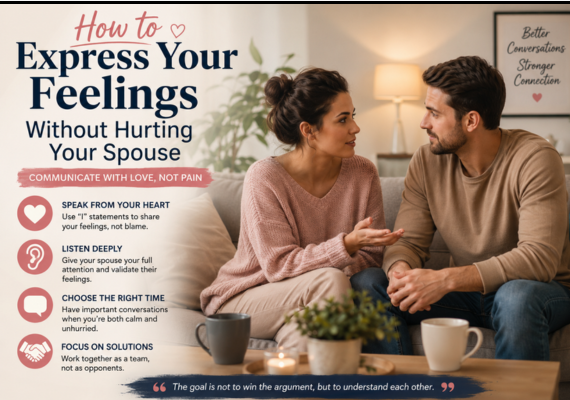
Use “I” Statements Instead of Blaming Your Spouse
One of the most effective communication techniques I recommend is using “I” statements.
This approach allows you to communicate your feelings without making your spouse feel attacked.
When conversations begin with accusations, people naturally become defensive. Their attention shifts away from your emotions and toward proving they are not at fault.
Instead of focusing on blame, describe your own experience.
For example, compare these statements:
Blaming statement:
“You never spend time with me anymore.”
Healthy statement:
“I feel lonely because I miss spending quality time together.”
Another example:
Blaming statement:
“You never listen when I talk.”
Healthy statement:
“I sometimes feel unheard when I’m speaking, and I’d really appreciate having your full attention.”
Notice how the second examples communicate exactly the same concern while inviting empathy instead of conflict.
Using “I” statements does not weaken your message. In fact, it makes your feelings much harder to dismiss because you are sharing your personal experience rather than attacking your spouse’s character.
This simple communication habit can dramatically reduce unnecessary arguments while strengthening emotional intimacy.
Be Honest Without Being Harsh
Honesty is one of the strongest foundations of a successful marriage, but honesty without kindness can easily become criticism. I have found that many couples confuse being brutally honest with being genuinely helpful. The truth is, honesty should strengthen your relationship, not damage it.
There is a significant difference between expressing your feelings and attacking your spouse. Honest communication focuses on explaining your emotions, while harsh communication focuses on pointing out faults.
Think about how differently these two statements sound:
Harsh:
“You never think about anyone but yourself.”
Honest and respectful:
“I felt hurt when my opinion wasn’t considered because I want to feel like we’re making decisions together.”
Both statements address the same issue, but only one opens the door to understanding.
Choosing gentle words does not mean you are avoiding the truth. It means you value your marriage enough to communicate in a way that encourages your spouse to listen instead of defend themselves.
Another helpful habit is to avoid exaggerations such as:
- “You always…”
- “You never…”
- “Every single time…”
- “Nothing you do is ever right.”
These phrases often make your spouse focus on proving you wrong rather than understanding how you feel.
Instead, describe the specific situation that bothered you.
For example:
“When we were talking last night and you started looking at your phone, I felt like what I was saying wasn’t important.”
This statement is specific, fair, and much easier to respond to positively.
Being honest also means being vulnerable. Sometimes saying, “I feel insecure,” or “I need more reassurance,” requires more courage than expressing anger. Yet vulnerability often creates deeper emotional intimacy because it allows your spouse to see what is truly happening in your heart.
Remember, the purpose of honesty is not to hurt your spouse with the truth. It is to help them understand you better.
Listen as Much as You Speak
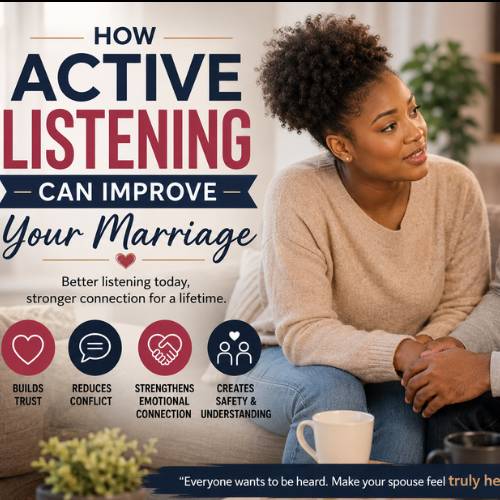
One of the biggest mistakes couples make is believing communication is mostly about talking. In reality, effective communication is equally about listening.
After expressing your feelings, give your spouse the opportunity to explain their perspective without interrupting. This does not mean you must immediately agree with everything they say. It simply means you are willing to understand before reaching conclusions.
Many misunderstandings happen because one spouse is already preparing a response while the other person is still speaking.
Active listening requires patience.
As your spouse speaks, focus on understanding rather than defending yourself. Pay attention to their words, tone, and emotions.
You can encourage healthy communication by saying things like:
- “Can you help me understand what you meant?”
- “Tell me more about how you felt.”
- “I want to understand your perspective.”
- “Thank you for explaining that.”
These responses show emotional maturity and create a safe environment for honest conversations.
Sometimes your spouse simply wants to feel heard before discussing solutions.
For example, if your spouse says they feel overwhelmed with household responsibilities, immediately explaining why you have been busy may make them feel dismissed.
Instead, try saying:
“I didn’t realize you were feeling that way. Thank you for telling me. I understand why that has been frustrating.”
Validation is not the same as agreement.
It simply communicates that you recognize your spouse’s emotions as real and important.
When both partners feel heard, finding solutions becomes much easier.
Control Your Tone, Body Language, and Words
Communication involves much more than spoken words.
Your tone of voice, facial expressions, eye contact, posture, and body language all influence how your message is received.
You may say kind words, but if they are delivered with sarcasm, eye-rolling, or an angry tone, your spouse will likely focus on your attitude instead of your message.
Imagine hearing this statement in two different tones:
“I’m fine.”
One tone may sound calm and reassuring.
Another may clearly communicate disappointment or frustration.
The words are identical, yet the meaning changes completely.
This is why emotional control is so valuable during difficult conversations.
Before responding, pause if necessary.
Take a deep breath.
Lower your voice.
Speak slowly.
These simple actions reduce emotional tension and make productive conversations much more likely.
It is equally important to avoid interrupting your spouse.
Allow them to finish speaking before responding.
When both people feel respected, conversations become more constructive and far less emotionally exhausting.
Remember, your goal is not simply to communicate information. Your goal is to communicate love, respect, and understanding even while discussing difficult topics.
Focus on Solving the Problem, Not Winning the Argument
Marriage is not a competition.
Unfortunately, many couples unknowingly approach disagreements as battles that must have a winner and a loser.
When your objective becomes proving your spouse wrong, both of you lose.
Healthy marriages focus on solving problems together instead of assigning blame.
Rather than asking yourself:
“How can I prove I’m right?”
Ask:
“How can we solve this together?”
That small mindset shift changes the direction of the conversation.
For example, suppose finances have become a source of tension.
Instead of saying:
“You waste too much money.”
You could say:
“I’m feeling anxious about our finances. Can we work together on a budget that helps both of us feel more secure?”
The conversation immediately becomes collaborative instead of confrontational.
Another helpful habit is acknowledging your spouse’s efforts.
Even during disagreements, recognize what they are doing well.
For example:
“I know you’ve been working very hard lately, and I appreciate that. I just miss spending more time together.”
This balanced approach reminds your spouse that your concern is about improving the relationship—not criticizing them as a person.
The strongest couples do not avoid conflict.
They learn how to face problems as teammates rather than opponents.
What to Avoid When Expressing Your Feelings
Sometimes knowing what not to do is just as valuable as knowing what to do.
Certain communication habits quickly damage trust and make productive conversations much harder.
Avoid these common mistakes whenever possible:
- Bringing up old arguments that have already been resolved.
- Using insults, name-calling, or disrespectful language.
- Interrupting your spouse before they finish speaking.
- Assuming you know their intentions without asking.
- Giving the silent treatment instead of communicating.
- Raising your voice to gain control of the conversation.
- Comparing your spouse to other people or other marriages.
- Discussing sensitive issues in front of children or other family members.
These behaviors shift the focus away from resolving the issue and often create entirely new problems.
If emotions become overwhelming, it is perfectly acceptable to take a short break.
You might say:
“I’m feeling too emotional right now, and I don’t want to say something I’ll regret. Can we continue this conversation in about thirty minutes?”
This demonstrates emotional maturity rather than avoidance.
Healthy communication is not about saying everything immediately.
It is about saying the right things in the right way at the right time.
Examples of Healthy Ways to Express Difficult Feelings
Sometimes it is easier to understand healthy communication by seeing practical examples.
Here are a few situations many married couples experience.
Example 1: Feeling unappreciated
Instead of saying:
“You never appreciate anything I do.”
Try saying:
“I’ve been feeling unnoticed lately, and hearing a simple ‘thank you’ would mean a lot to me.”
Example 2: Feeling lonely
Instead of saying:
“You care more about your phone than me.”
Try saying:
“I really miss the quality time we used to spend together. I’d love for us to have an evening without distractions.”
Example 3: Feeling disappointed
Instead of saying:
“You ruined our plans again.”
Try saying:
“I was disappointed because I was looking forward to spending time together. Can we plan another day?”
Example 4: Feeling overwhelmed
Instead of saying:
“You never help around the house.”
Try saying:
“I’ve been feeling overwhelmed with everything I need to do. I’d really appreciate it if we could share some of the responsibilities.”
These examples communicate feelings clearly while encouraging understanding instead of defensiveness.
Small changes in wording often produce dramatically different results.
How to Rebuild Connection After a Difficult Conversation
Even when you communicate with patience and respect, not every conversation will end perfectly. There may be moments when emotions run high, misunderstandings occur, or one of you says something you later regret. From my experience, what determines the strength of a marriage is not whether difficult conversations happen, but how couples reconnect afterward.
After discussing a sensitive issue, avoid walking away as if nothing happened. Instead, take intentional steps to rebuild emotional closeness. This reassures your spouse that your relationship is always more important than the disagreement itself.
A sincere apology can go a long way if your words or tone caused pain. An apology should acknowledge the hurt without making excuses. For example, you could say:
“I’m sorry for the way I spoke to you. I was frustrated, but I shouldn’t have expressed myself like that.”
Likewise, if your spouse apologizes, be willing to receive it with grace. Holding onto resentment after a genuine apology only creates emotional distance. Forgiveness does not mean forgetting what happened overnight, but it does mean choosing to move forward together.
Rebuilding connection can also involve simple gestures that remind your spouse they are loved. These may include:
- Sharing a warm hug.
- Holding hands while talking.
- Preparing their favorite meal.
- Spending uninterrupted quality time together.
- Saying, “I love you,” even after a disagreement.
These actions communicate that although the issue needed to be addressed, your commitment to each other remains strong.
It is also helpful to reflect on the conversation together. Ask questions like:
- What did we do well during that discussion?
- What can we improve next time?
- Did we both feel heard?
- How can we handle similar situations better in the future?
Viewing each difficult conversation as an opportunity to strengthen your communication skills helps your marriage grow stronger over time.
Read: How to Rebuild Trust After Breaking It in Marriage (Simple and Romantic Way)
Common Mistakes Couples Make When Communicating Their Feelings
Even couples with the best intentions can fall into unhealthy communication habits. Recognizing these mistakes is the first step toward avoiding them.
One of the biggest mistakes is expecting your spouse to read your mind. You may believe your emotions are obvious, but unless you express them clearly, your spouse may have no idea what you are experiencing.
Another common mistake is waiting too long to discuss a problem. When feelings are ignored, they often grow into resentment. Eventually, something small triggers an emotional reaction that seems far bigger than the situation itself.
Many couples also make the mistake of focusing only on negative issues. If every serious conversation centers around complaints, your spouse may begin to associate communication with criticism.
Healthy marriages also include conversations about appreciation, encouragement, dreams, and gratitude.
For example, instead of only saying:
“I don’t like when you do that.”
Also make it a habit to say:
“I really appreciated how you supported me today.”
Positive communication strengthens your relationship and makes it easier to discuss difficult topics when they arise.
Another mistake is trying to solve every issue immediately.
Sometimes your spouse simply needs time to process what has been shared. Allowing space for reflection can lead to calmer and more productive discussions later.
Finally, never compare your marriage to someone else’s.
Every couple has different personalities, challenges, and communication styles. Focus on building a healthy relationship based on mutual respect instead of unrealistic comparisons.
Progress in communication happens through consistent effort, not perfection.
Frequently Asked Questions (FAQ)
Can I express negative feelings without hurting my spouse?
Yes. The key is to focus on your emotions instead of attacking your spouse’s character. Explain how you feel using calm, respectful language and be willing to listen to their perspective. Honest communication delivered with kindness is much less likely to cause unnecessary hurt.
What if my spouse becomes defensive every time I express my feelings?
Defensiveness often happens when someone feels criticized or blamed. Choose a calm time to talk, use “I” statements, avoid exaggerations like “always” or “never,” and reassure your spouse that your goal is to strengthen the relationship, not start an argument.
Is it better to stay quiet to avoid conflict?
No. Constantly suppressing your emotions usually leads to frustration and resentment over time. Healthy marriages require honest communication. The goal is not to avoid difficult conversations but to approach them with love, patience, and respect.
How can I stay calm during emotional conversations?
Take a moment to breathe before responding, speak slowly, and focus on understanding rather than winning the discussion. If emotions become overwhelming, suggest taking a short break before continuing the conversation.
How often should couples talk about their feelings?
There is no perfect schedule, but couples benefit from checking in with each other regularly. Even a few uninterrupted minutes each day can help you discuss concerns, celebrate successes, and strengthen your emotional connection before small issues become larger problems.
Conclusion
Learning how to express your feelings without hurting your spouse is one of the most valuable skills you can develop in marriage. Honest communication is not about avoiding difficult conversations or pretending everything is perfect. It is about speaking the truth with kindness, empathy, and respect.
When you understand your emotions before speaking, choose the right time for important discussions, use “I” statements, listen carefully, and focus on solving problems together, you create an environment where both you and your spouse feel safe to be open and vulnerable.
Remember that no couple communicates perfectly all the time. Every marriage experiences misunderstandings and disagreements. What sets strong marriages apart is the willingness to learn, grow, apologize when necessary, and keep choosing each other through every season of life.
As you begin applying these communication principles, you will likely notice fewer unnecessary arguments, greater emotional intimacy, and a deeper sense of trust. Small, consistent changes in the way you express your feelings can have a lasting impact on your relationship.
Marriage is built one conversation at a time. Make each conversation an opportunity to strengthen your bond, deepen your understanding, and remind your spouse that they are loved, respected, and valued.

Daniel Master is a relationship and marriage writer passionate about helping readers build healthier relationships, stronger marriages, and more meaningful connections. Through practical advice, thoughtful insights, and fresh perspectives on weddings and modern relationships, Daniel creates easy-to-understand content designed to help readers make confident decisions in love and life.