Relationship conflicts are often misunderstood as a sign that something is “wrong” with the relationship, when in reality, they are a natural part of emotional connection between two people. In my experience working with relationship dynamics and long-term couples, conflict is not the problem—how couples respond to it is what determines whether the relationship grows stronger or falls apart. The focus keyword here, how to resolve relationship conflicts without breaking up, is especially important because many couples reach a point where emotions escalate faster than communication skills can keep up.
When I look at healthy long-term relationships, I consistently notice one pattern: couples who stay together are not the ones who avoid conflict, but the ones who learn how to navigate it with emotional maturity. Disagreements become dangerous only when they turn into blame, silence, or emotional withdrawal. Otherwise, conflict can actually become a tool for deeper understanding.
This article is structured to help break down practical, real-world methods that support emotional connection during disagreements. The goal is not to eliminate conflict entirely, but to help you handle it in a way that preserves trust, respect, and emotional safety.
What Causes Most Relationship Conflicts in Modern Relationships
Most relationship conflicts do not start with the actual issue being argued about. In reality, surface-level arguments—such as money, time, attention, or household responsibilities—are usually symptoms of deeper emotional needs not being met. One partner may feel unheard, while the other may feel unappreciated or misunderstood. These hidden emotional layers are often what fuel repeated disagreements.
Another major cause of conflict is expectation mismatch. Many couples enter relationships with unspoken expectations about communication style, affection, or roles within the relationship. When reality doesn’t match those expectations, frustration builds quickly. For example, one partner might expect constant emotional check-ins, while the other believes showing love through actions is enough. Without clarity, both feel neglected in different ways.
External stress also plays a huge role. Work pressure, financial strain, family expectations, and personal insecurity can all spill into the relationship. When emotional bandwidth is already low, even small issues can trigger intense arguments.
Understanding these root causes is essential because resolving conflict without breaking up begins with identifying what is actually driving the disagreement—not just what is being said in the moment.
Why Couples Should Learn Conflict Resolution Instead of Walking Away
One of the biggest misconceptions in modern relationships is that walking away is always the healthiest option when conflict becomes uncomfortable. While there are situations where separation is necessary, most everyday relationship conflicts are not deal-breakers—they are skill gaps in communication and emotional regulation.
When couples avoid learning conflict resolution skills, they often repeat the same patterns in future relationships. The same triggers resurface, just with different people. On the other hand, couples who learn how to resolve disagreements develop emotional resilience. They become better at expressing needs clearly and responding with empathy rather than defensiveness.
I often remind couples that love alone is not enough to sustain a relationship. Love needs structure, communication, and repair skills. Without those, even strong emotional connections can collapse under repeated misunderstandings.
Choosing to learn conflict resolution is essentially choosing long-term emotional stability over short-term emotional escape. It builds a foundation where disagreements no longer threaten the relationship but instead strengthen it.
Recognizing Emotional Triggers and Communication Breakdowns
One of the most important steps in resolving relationship conflicts is learning to identify emotional triggers. A trigger is not just what upsets you—it is the deeper emotional wound that gets activated during a disagreement. For example, a partner forgetting an important date may trigger feelings of being unimportant or unloved, even if the intention was not hurtful.
Communication breakdowns usually happen when these triggers are not recognized. Instead of expressing the real emotion, couples react with anger, sarcasm, silence, or criticism. The actual message gets lost behind emotional reactions, and the conflict escalates unnecessarily.
A practical approach I often recommend is pausing during an argument to mentally ask: “What am I really feeling right now?” and “What deeper need is not being met?” This shift alone can transform the direction of a conversation.
When both partners begin to understand each other’s triggers, conflicts become less personal and more solution-focused. Instead of attacking each other, the focus shifts to protecting emotional safety.
How to Communicate Without Blame During Arguments
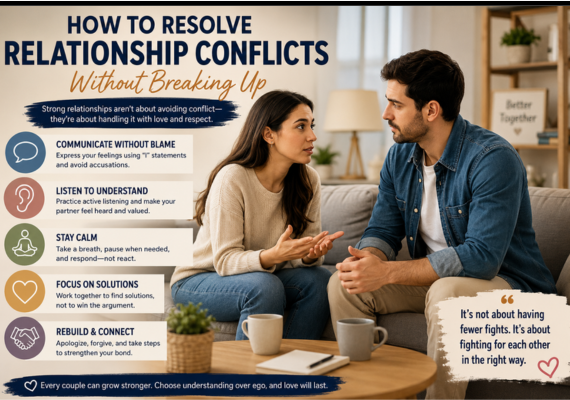
Blame is one of the fastest ways to escalate conflict in a relationship. It creates defensiveness, shuts down empathy, and turns a shared problem into a personal attack. A more effective approach is using responsibility-based communication instead of accusation-based language.
Instead of saying “You never listen to me,” a healthier expression would be “I feel unheard when I’m talking and there’s no response.” The difference may seem small, but emotionally it changes everything. One statement triggers defense; the other invites understanding.
I always encourage couples to focus on “I statements” because they keep the conversation rooted in personal experience rather than judgment. This reduces emotional tension and increases the likelihood of resolution.
Another important communication habit is avoiding absolutes like “always” and “never.” These words exaggerate behavior and often make the other partner feel misunderstood. Real issues are rarely absolute—they are patterns, not permanent truths.
Learning non-blaming communication is one of the most powerful tools in how to resolve relationship conflicts without breaking up because it preserves dignity on both sides of the conversation.
Read: Best Communication Tips for Long-Distance Couples: Stay Connected From Anywhere
Active Listening Skills That Help Couples Understand Each Other Better
Active listening is more than just hearing words—it is the ability to fully understand your partner’s emotional message without preparing a response while they are speaking. Many conflicts persist simply because one or both partners are not truly listening to understand.
A key part of active listening is reflecting back what your partner said. For example, responding with “What I hear you saying is that you felt ignored when I was busy” shows that you are processing their emotions, not just their words. This immediately reduces tension because it makes the other person feel acknowledged.
Another important element is avoiding interruptions. Even if you disagree, allowing your partner to fully express themselves before responding prevents emotional escalation. Interruptions often signal invalidation, even when that is not the intention.
Active listening also includes paying attention to tone, body language, and emotional cues. Sometimes what is not said is just as important as what is said.
When practiced consistently, active listening transforms arguments into conversations. It builds emotional safety, which is essential for resolving conflicts without damaging the relationship.
How to Stay Calm and Avoid Saying Hurtful Things in the Heat of the Moment
One of the most damaging patterns in relationship conflicts is reacting faster than thinking. In heated moments, emotional intensity rises, and words often come out sharper than intended. The challenge is not the presence of anger—it is the inability to regulate it before it turns into verbal damage.
A practical approach I often recommend is learning to recognize early physical signs of escalation. These can include a racing heart, tightened chest, raised voice, or the urge to “win” the argument. Once these signals appear, it becomes much harder to communicate rationally unless a pause is taken.
Taking a short break during intense arguments is not avoidance; it is emotional control. A simple statement like “I need a few minutes to calm down so I can respond better” can prevent long-term emotional damage. The key is to return to the conversation, not disappear from it.
It is also important to avoid “word weapons” during conflict—phrases meant to hurt rather than solve. Even if emotions feel justified, words spoken in anger can leave lasting emotional scars that take longer to repair than the original issue itself.
Learning emotional regulation is one of the most powerful skills in how to resolve relationship conflicts without breaking up because it protects the relationship from unnecessary emotional harm.
The Importance of Timing When Discussing Sensitive Issues
Timing plays a critical role in whether a conversation leads to resolution or escalation. Many couples attempt to solve serious issues at the worst possible moments—when one partner is tired, distracted, stressed, or emotionally unavailable.
Healthy communication requires emotional readiness from both sides. Bringing up sensitive topics when your partner is exhausted or preoccupied often leads to defensive responses rather than productive dialogue. Choosing the right time shows respect for emotional space and increases the chances of being heard.
I often advise couples to “schedule emotional conversations” when possible. This does not make the relationship robotic; instead, it creates structure around important discussions. For example, saying “Can we talk about this after dinner when we’re both relaxed?” helps both partners prepare mentally.
Another overlooked factor is environment. A calm, private setting supports better communication than a noisy or stressful environment. Emotional conversations require mental focus, not distractions.
When timing is handled correctly, even difficult topics become easier to navigate. It reduces unnecessary tension and increases emotional cooperation.
Practical Steps to Resolve Conflicts Without Escalating Tension
Resolving conflict effectively requires structure, not improvisation. Without a clear approach, conversations tend to drift into blame, repetition, or emotional shutdown. A more intentional process helps keep both partners aligned toward solutions.
A useful step is identifying the exact issue before responding emotionally. Many arguments expand because the real problem is never clearly defined. Clarifying the issue early helps prevent misunderstanding.
Another important step is separating emotions from solutions. It is okay to express feelings first, but the conversation should eventually shift toward what can actually be done differently moving forward. Staying stuck in emotion alone rarely leads to resolution.
It also helps to agree on one goal during disagreements: resolution, not victory. When one partner tries to “win,” the relationship itself loses. But when both focus on understanding and fixing the issue, progress becomes possible.
Small agreements, even during disagreement, also help reduce tension. Phrases like “I understand why you feel that way” or “I see your point” do not mean full agreement, but they create emotional balance that supports resolution.
When to Compromise and When to Stand Your Ground in a Relationship
Compromise is essential in relationships, but not every issue should be compromised. One of the most important emotional skills is knowing the difference between flexible preferences and core values.
Compromise works best when the issue involves lifestyle preferences, habits, or temporary situations. For example, deciding how to spend weekends or divide chores can often be negotiated without emotional harm.
However, standing your ground becomes necessary when core values, emotional safety, respect, or boundaries are involved. For example, disrespectful communication or repeated emotional neglect should not be normalized in the name of compromise.
I often advise couples to ask themselves: “Is this about preference or principle?” This question helps clarify whether flexibility is healthy or harmful.
Healthy relationships are not built on constant sacrifice from one side. True compromise involves mutual adjustment, where both partners give and receive equally over time.
How to Rebuild Trust and Emotional Connection After a Conflict
Even after a conflict is resolved, emotional distance can linger. This is where rebuilding connection becomes important. Trust is not only broken by major issues—it can also weaken through repeated unresolved misunderstandings.
Rebuilding begins with consistency. Small actions that show reliability and emotional presence help restore safety over time. Apologies alone are not enough; behavior must align with words.
Emotional connection can also be restored through intentional bonding moments after conflict. Simple acts like checking in, spending quality time, or expressing appreciation help reset emotional energy.
It is also important to avoid reopening resolved issues repeatedly. Once a conflict has been addressed, constantly revisiting it can damage trust and prevent healing.
Reconnection is a gradual process. It requires patience, emotional stability, and a shared willingness to move forward instead of staying stuck in past arguments.
Common Mistakes Couples Make That Lead to Breakups
Many breakups do not happen because of a single conflict, but because of repeated patterns that slowly weaken emotional connection. One of the most common mistakes is ignoring small issues until they become major problems.
Another mistake is using silence as punishment. Withdrawing communication without explanation creates emotional insecurity and distance, which can be more damaging than the original conflict.
Some couples also fall into the habit of keeping score—tracking who was right or wrong in past arguments. This mindset turns the relationship into a competition rather than a partnership.
Avoiding difficult conversations entirely is another major issue. While it may feel easier in the moment, unresolved tension builds over time and eventually surfaces in more intense ways.
Recognizing these patterns early is essential for maintaining a stable relationship.
When to Seek Professional Help or Relationship Counseling
There are times when couples need support beyond personal effort. Seeking professional help is not a sign of failure; it is a proactive step toward healthier communication.
Counseling becomes especially important when conflicts become repetitive without resolution, when emotional safety is consistently affected, or when communication completely breaks down.
A neutral third party can help identify patterns that couples may not see on their own. It also provides structured guidance for rebuilding trust and improving communication.
I often view counseling as a relationship “reset tool” rather than a last resort. It helps couples learn skills that strengthen long-term emotional stability.
Conclusion
Learning how to resolve relationship conflicts without breaking up is ultimately about emotional maturity, communication skills, and mutual respect. Conflict itself is not the enemy—unresolved conflict is.
When couples commit to understanding each other, improving communication, and managing emotions effectively, disagreements become opportunities for growth rather than threats to the relationship.
A strong relationship is not one without problems, but one where both partners know how to face problems together without losing connection in the process.

Daniel Master is a relationship and marriage writer passionate about helping readers build healthier relationships, stronger marriages, and more meaningful connections. Through practical advice, thoughtful insights, and fresh perspectives on weddings and modern relationships, Daniel creates easy-to-understand content designed to help readers make confident decisions in love and life.