Few artists in history have reshaped the direction of art as profoundly as Pablo Picasso. His groundbreaking experiments with form, perspective, and artistic freedom transformed the visual language of the twentieth century and continue to influence artists today. Even decades after his passing, Picasso’s legacy remains deeply embedded in the foundations of contemporary art.
From my experience observing gallery exhibitions and studying the evolution of modern art, Picasso’s influence appears almost everywhere. Whether in abstract compositions, expressive portraiture, or experimental sculpture, traces of his ideas continue to appear in the work of artists across generations. His willingness to challenge conventions encouraged countless artists to question traditional rules and explore entirely new ways of creating art.
What makes Picasso’s legacy particularly powerful is that he did not confine himself to one artistic style. Throughout his career, he moved fluidly between movements and techniques, constantly reinventing his approach. From the emotional tones of his Blue Period to the revolutionary breakthroughs of Cubism, Picasso consistently pushed the boundaries of what art could be.
This fearless experimentation inspired later artists to adopt a similar mindset. Rather than simply imitating Picasso’s visual style, many artists embraced his spirit of innovation. They explored fragmentation, distortion, and abstraction as tools for expressing complex ideas about identity, perception, and modern life.
As a result, Picasso’s influence extends far beyond his own artwork. His legacy lives on through generations of artists who continue to reinterpret his ideas in new and surprising ways.
Understanding Picasso’s Artistic Legacy and Why It Still Matters
To understand why Picasso continues to inspire artists today, it is important to recognize the revolutionary nature of his work. Picasso did not merely create beautiful paintings; he fundamentally changed the way artists think about representation.
Before the emergence of modern art, Western painting largely followed traditional rules of perspective and realism. Artists attempted to replicate the visible world as accurately as possible. Picasso challenged this idea by suggesting that reality could be interpreted through multiple perspectives at once.
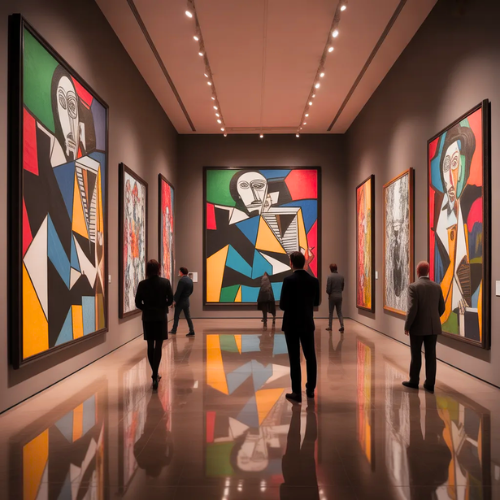
His role in the development of Cubism marked a turning point in art history. By breaking objects into geometric fragments and presenting multiple viewpoints simultaneously, Picasso and his collaborators redefined how space and form could be represented on a canvas.
This approach allowed artists to move beyond simple imitation of the physical world. Instead, they could explore how perception, memory, and emotion shape the way people experience reality.
In gallery exhibitions today, I often see artists referencing this idea in subtle ways. A portrait might distort facial features to emphasize psychological expression, while a landscape painting might fragment space to reflect emotional atmosphere rather than literal scenery.
Picasso’s legacy also extends to his relentless curiosity. Throughout his career, he experimented with sculpture, ceramics, printmaking, and collage. This openness to different mediums encouraged future artists to embrace interdisciplinary creativity.
Ultimately, Picasso’s importance lies not only in what he created but also in how he transformed artistic thinking. His work opened the door for generations of artists to approach art as an evolving exploration rather than a fixed set of rules.
Key Elements of Picasso’s Style That Continue to Inspire Artists
Artists influenced by Picasso often draw inspiration from several distinctive elements that defined his artistic approach. These characteristics continue to shape contemporary art in both direct and subtle ways.
One of the most recognizable elements is the fragmentation of form. Instead of depicting subjects as unified objects, Picasso often broke them into geometric shapes and overlapping planes. This technique allowed him to represent multiple perspectives simultaneously, creating dynamic compositions that feel both analytical and expressive.
Another influential element is his use of distortion. Picasso frequently exaggerated proportions, simplified anatomy, or rearranged facial features to emphasize emotional or psychological depth. Rather than striving for perfect realism, he prioritized expressive impact.
Many contemporary artists continue to use distortion as a tool for storytelling. A portrait with exaggerated features, for example, can reveal something deeper about the subject’s character or inner state.
Picasso also embraced experimentation with materials. His pioneering use of collage introduced everyday materials such as newspaper clippings, printed paper, and fabric into fine art compositions. This approach blurred the boundaries between traditional art and ordinary objects.
Several artistic principles from Picasso’s work still resonate with modern creators:
- Viewing subjects from multiple perspectives
- Breaking forms into abstract geometric shapes
- Emphasizing emotional expression over realism
- Experimenting with unconventional materials
These elements allow artists to reinterpret reality rather than simply reproduce it. From my perspective within the gallery world, this freedom remains one of Picasso’s most enduring contributions to artistic practice.
Artist Spotlight: Francis Bacon and the Reinvention of Figurative Art
Among the many artists influenced by Picasso’s legacy, Francis Bacon stands out for his intense and emotionally charged interpretations of the human figure.
Bacon’s work often features distorted bodies trapped within stark, abstract spaces. At first glance, his paintings can appear unsettling, but their power lies in the raw emotional energy they convey. Like Picasso, Bacon believed that art should capture deeper psychological truths rather than simply replicate appearances.
The influence of Picasso on Bacon’s work is particularly evident in his treatment of the human figure. Bacon frequently deconstructed facial features and body forms, rearranging them into dynamic compositions that feel both chaotic and deeply expressive.
In several of his paintings, the figure seems to dissolve into sweeping brushstrokes and fragmented shapes. This approach echoes Picasso’s belief that the human form could be reinterpreted through abstraction and distortion.
From a gallery perspective, Bacon’s work demonstrates how Picasso’s ideas about fragmentation and expressive distortion evolved in the hands of later artists. While Bacon’s style is unmistakably his own, the philosophical foundation of his work reflects the groundbreaking freedom Picasso introduced to modern art.
Bacon’s paintings continue to captivate audiences because they confront viewers with the raw intensity of human emotion. In doing so, they show how Picasso’s influence extends far beyond visual technique into the deeper psychological possibilities of art.
Artist Spotlight: David Hockney and His Dialogue with Picasso’s Innovation
Another artist whose work reflects the influence of Picasso’s revolutionary ideas is David Hockney. Known for his vibrant landscapes, experimental photography, and innovative use of technology, Hockney has long been fascinated by the challenge of representing space and perspective.
Hockney’s work often explores the concept of seeing from multiple viewpoints, an idea that resonates strongly with Picasso’s exploration of Cubism. Rather than relying on traditional single-point perspective, Hockney frequently constructs images from numerous viewpoints combined into a single composition.
One of his most intriguing experiments involved photographic collages that assembled dozens of images into fragmented scenes. These works capture different angles and moments simultaneously, creating a visual experience that feels closer to human perception than a single photograph.
This method closely parallels Picasso’s approach in Cubism, where objects are depicted from several perspectives at once. However, Hockney adapts the idea for a contemporary context, incorporating photography, digital technology, and new media.
From my experience visiting exhibitions of Hockney’s work, it becomes clear that he shares Picasso’s curiosity about how people perceive space and time. Both artists question the limitations of traditional representation and explore more dynamic ways of visualizing reality.
Hockney’s continued experimentation demonstrates that Picasso’s influence is not limited to a specific style. Instead, it encourages artists to rethink fundamental artistic concepts such as perspective, perception, and visual storytelling.
Artist Spotlight: Jean-Michel Basquiat and the Raw Energy of Expression
Among contemporary artists influenced by Picasso, Jean-Michel Basquiat stands out for his visceral, unfiltered approach to painting. Basquiat’s work combines graffiti-inspired energy with an intense engagement with history, culture, and identity, reflecting a fearless approach to expression reminiscent of Picasso’s experimental spirit.
Basquiat often employed fragmented forms, bold lines, and a raw, almost primitive aesthetic that draws parallels to the freedom Picasso explored in Cubism and African-influenced artworks. He reinterpreted the human figure, distorting anatomy and layering symbols, text, and imagery to create paintings that feel both chaotic and profoundly intentional.
In gallery settings, Basquiat’s pieces demand attention. Viewers are drawn into vibrant compositions that merge cultural critique, personal narrative, and historical reflection. This approach mirrors Picasso’s philosophy: the artist does not simply replicate reality but reimagines it through a lens of emotional and intellectual depth.
Basquiat’s work also demonstrates the continued relevance of Picasso’s idea that art can challenge social norms. Through his exploration of race, identity, and power, Basquiat expanded the scope of contemporary art, showing that painting can serve as a tool for cultural commentary and activism.
Artist Spotlight: George Condo and the Evolution of Psychological Cubism
George Condo offers another compelling example of Picasso’s lasting influence. Condo’s work is often described as “psychological Cubism,” a term that reflects his unique combination of Cubist fragmentation and intense character-driven portraiture.
In his paintings, Condo deconstructs human faces and figures into angular shapes and exaggerated forms. Like Picasso, he manipulates perspective and anatomy to create surreal, emotionally charged compositions. However, Condo’s approach emphasizes psychological states, exploring the inner lives of his subjects rather than formal experimentation alone.
From my perspective working with galleries, Condo’s work exemplifies how Picasso’s influence evolves across generations. While the visual language of Cubism provided the foundation, Condo applies it to new conceptual territory, highlighting emotional and psychological complexity within contemporary portraiture.
His portraits often blend humor, grotesque exaggeration, and sophisticated composition, offering viewers a layered experience that challenges traditional notions of identity and representation. Condo’s approach underscores the enduring versatility of Picasso’s techniques, proving that Cubism and abstraction remain fertile ground for innovation.
Artist Spotlight: Julian Schnabel and Neo-Expressionist Influence
Another artist deeply inspired by Picasso’s legacy is Julian Schnabel. Known for his large-scale paintings and use of unconventional materials, Schnabel’s work exemplifies the way Picasso’s experimental spirit continues to inform modern artistic practices.
Schnabel often incorporates broken plates, found objects, and layered textures into his canvases, creating work that feels both tactile and monumental. His expressive brushwork and abstracted figures recall the freedom of form and energy seen in Picasso’s paintings, while his scale and theatricality bring a uniquely contemporary perspective.
In exhibitions, Schnabel’s pieces dominate the space, inviting viewers to engage with art physically as well as visually. This immersive quality reflects the way Picasso transformed the relationship between artwork and audience, emphasizing dynamic interaction and emotional resonance.
Schnabel’s contribution highlights how Picasso’s influence extends beyond formal techniques. It encompasses a philosophy of art-making that values risk-taking, bold experimentation, and the integration of unconventional materials into serious artistic expression.
How Picasso’s Cubism Continues to Shape Contemporary Art
One of the most enduring aspects of Picasso’s influence is his development of Cubism. This radical approach to form, perspective, and spatial representation continues to resonate with artists today.
Cubism encouraged the breakdown of objects into geometric shapes and the representation of multiple perspectives simultaneously. Contemporary artists often borrow these principles to explore abstraction, perception, and psychological complexity in their work.
In modern galleries, I frequently observe artists applying Cubist principles in unexpected ways: layered digital compositions, fragmented figurative paintings, and interactive installations that invite viewers to consider multiple viewpoints. The foundational ideas of Cubism provide a versatile framework for both conceptual exploration and aesthetic experimentation.
Cubism also set a precedent for artists to challenge the dominance of realism. By demonstrating that perception and interpretation could take precedence over photographic accuracy, Picasso opened the door for generations of innovators to explore abstraction, distortion, and creative freedom.
The Role of Picasso’s Legacy in Today’s Art Galleries and Exhibitions
Picasso’s influence is not only evident in artistic production but also in how galleries and museums curate and present contemporary art. Exhibitions frequently highlight artists whose work engages with Cubist ideas, abstraction, and expressive experimentation, creating a direct dialogue with Picasso’s legacy.
From a curatorial perspective, including artists inspired by Picasso enriches the narrative of contemporary exhibitions. It provides historical context while emphasizing the ongoing evolution of modern art. Visitors can see connections between Picasso’s groundbreaking techniques and the diverse approaches of today’s painters, sculptors, and mixed-media artists.
Gallery programs often showcase how contemporary artists reinterpret traditional forms, inviting audiences to consider the continuum of artistic innovation. This approach highlights the enduring relevance of Picasso’s ideas in shaping both artistic creation and public understanding of modern art.
Emerging Artists Drawing Inspiration from Picasso’s Vision
In addition to established figures, a new generation of artists continues to engage with Picasso’s influence in inventive ways. These emerging artists often merge Cubist principles with contemporary media, such as digital painting, virtual reality, and mixed-media installations.
Some notable trends among these artists include:
- Fragmentation of form applied to digital and immersive media
- Abstracted representations of identity and emotion
- Experimentation with texture, layering, and unconventional materials
- Multidimensional approaches to perspective and narrative
By engaging with Picasso’s ideas, these artists demonstrate that his influence is not static. It evolves with each generation, inspiring new forms of expression and ways of thinking about art.
Why Picasso’s Influence Remains Powerful in the Contemporary Art Market
Collectors and curators continue to value artists influenced by Picasso because his legacy represents both historical significance and creative innovation. Artworks that reference or reinterpret Picasso’s ideas often carry conceptual depth, technical sophistication, and a connection to one of the most influential figures in modern art.
From a market perspective, artists whose work engages with Picasso’s legacy often achieve strong institutional recognition, gallery representation, and collector interest. This attention reflects both the enduring cultural weight of Picasso’s contributions and the continued relevance of his ideas in contemporary practice.
Conclusion
Pablo Picasso’s influence on modern and contemporary art cannot be overstated. Through Cubism, abstraction, and relentless experimentation, he expanded the possibilities of artistic expression and inspired countless artists to rethink form, perspective, and emotion.
From Francis Bacon’s visceral figures to David Hockney’s inventive perspectives, Jean-Michel Basquiat’s raw energy, George Condo’s psychological deconstruction, and Julian Schnabel’s bold experimentation, Picasso’s legacy remains alive in diverse and vibrant ways.
As galleries, curators, and collectors continue to engage with artists inspired by Picasso, his ideas will persist, guiding new generations of creators who push boundaries, reinterpret reality, and redefine what contemporary art can be. Picasso’s vision, boldness, and creativity ensure that his legacy will continue shaping the art world for decades to come.