In my experience working closely with contemporary art and gallery programming, few artists have reshaped the global conversation around portraiture and identity as powerfully as Kehinde Wiley. His work does not simply present visually striking portraits; it challenges viewers to reconsider who has historically been represented in art and who has been excluded. When discussing art and identity today, Wiley’s name consistently emerges because his work addresses these issues with both elegance and unapologetic clarity.
Many visitors who walk into galleries for the first time encounter Wiley’s paintings and immediately feel a sense of familiarity mixed with surprise. The compositions resemble classical European portraits—the kind traditionally associated with aristocrats, royalty, and military figures. Yet the subjects are contemporary Black men and women, often dressed in modern clothing and portrayed with confidence and authority.
This visual tension is deliberate. Wiley has built his reputation by inserting modern Black subjects into artistic traditions that historically excluded them. Through this approach, he does more than create portraits; he reclaims space within art history. As a result, discussions around art and identity frequently begin with his work because it reveals how representation influences the way societies perceive power, culture, and belonging.
Who Is Kehinde Wiley? A Brief Artist Background
Kehinde Wiley’s artistic journey is rooted in both personal experience and deep art historical knowledge. Born in Los Angeles in 1977, Wiley grew up in a culturally rich environment that exposed him to art from an early age. His mother recognized his talent early and enrolled him in after-school art programs, giving him access to creative education that would later shape his career.
His formal training eventually took him to the prestigious Yale University School of Art, where he refined the technical mastery that now defines his paintings. During this period, Wiley developed an intense interest in classical European portraiture. He studied the works of artists such as Titian and Anthony van Dyck, learning how they used composition, posture, and symbolism to communicate power and status.
However, Wiley did not simply imitate historical techniques. Instead, he questioned them. He began asking a critical question that would shape his entire career: why were the individuals represented in these paintings almost exclusively European elites?
The answer to that question became the foundation of his artistic practice. Wiley decided to retain the grandeur and visual language of classical portraiture while replacing traditional subjects with people from modern urban communities. This decision transformed portraiture into a powerful commentary on identity, race, and representation.
The Concept of Identity in Contemporary Art
Identity has become one of the most discussed themes in contemporary art, and for good reason. Art has always reflected society, but modern artists increasingly use their work to question social structures, cultural narratives, and historical omissions.
In gallery settings, identity often appears through themes such as race, gender, heritage, and personal history. Artists are no longer simply documenting reality; they are interrogating it. They explore who gets visibility in culture and who remains unseen.
From my perspective as someone deeply engaged with gallery culture, Wiley’s work stands out because it addresses identity through the familiar structure of portraiture. Portraits historically served as symbols of power, wealth, and prestige. Kings, nobles, and military leaders commissioned these works to immortalize their influence.
By applying this visual language to contemporary Black subjects, Wiley disrupts centuries of artistic tradition. The result is not only visually captivating but also intellectually provocative. Viewers begin to question the power dynamics embedded in art history itself.
This approach makes his work particularly relevant in today’s cultural climate, where conversations about representation are more prominent than ever.
Inside the Interview: Kehinde Wiley on Art and Identity
When Wiley speaks about his work in interviews, he often returns to the idea that portraiture is never neutral. Every portrait carries a message about who matters in society. The choices an artist makes—who to paint, how to pose them, and what visual symbols surround them—can reinforce or challenge cultural narratives.
Wiley frequently describes his process as collaborative. Rather than painting distant or elite figures, he often meets his subjects directly in the street. In cities around the world, he approaches individuals whose style or presence catches his attention and invites them to participate in his work.
This method creates a unique dynamic. Instead of traditional patronage—where wealthy individuals commission their own portraits—Wiley flips the power structure. Ordinary people become the central figures in paintings that echo the grandeur of historical masterpieces.
During discussions about identity, Wiley emphasizes that representation has real social impact. When audiences see powerful imagery that reflects diverse identities, it reshapes cultural perception. Art begins to function not just as decoration but as a tool for cultural dialogue.
He also highlights the importance of visibility. For centuries, Black figures in Western art were either absent or depicted in subordinate roles. By placing them at the center of monumental paintings, Wiley reclaims visual authority and invites viewers to reconsider the historical narrative.
Reimagining Power and Representation in Portraiture
One of the most striking aspects of Wiley’s work is the way he redefines visual power. Traditional portraits relied heavily on symbols—armor, thrones, dramatic poses, and elaborate clothing—to signal authority. Wiley preserves these visual cues but recontextualizes them.
In many of his paintings, subjects adopt poses inspired by famous historical works. These poses might reference military leaders, noble figures, or mythological heroes. However, the individuals depicted are everyday people drawn from contemporary urban life.
This contrast produces a fascinating effect. The viewer recognizes the classical structure of the portrait but is confronted with a subject who historically would not have been included in that tradition. The painting becomes both familiar and revolutionary.
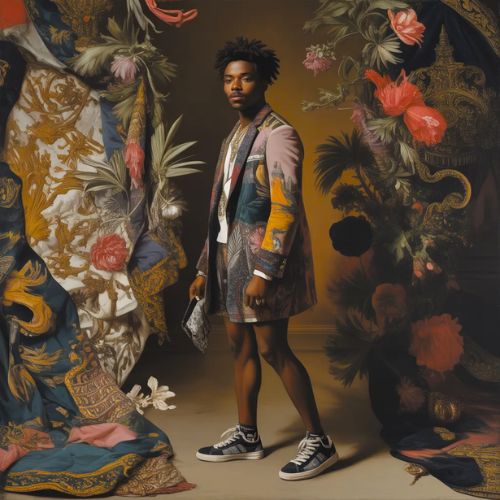
Another defining feature of Wiley’s style is his use of ornate decorative backgrounds. Lush floral patterns often extend across the canvas, sometimes intertwining with the figure itself. These patterns reference historical decorative arts while simultaneously creating a surreal visual environment.
From a gallery perspective, these backgrounds serve an important purpose. They draw viewers into the painting and create a visual tension between realism and abstraction. The subject remains lifelike and grounded, while the background suggests a symbolic, almost dreamlike world.
This combination reinforces Wiley’s central message: identity is complex, layered, and deeply connected to cultural history.
Cultural Influences That Shape Wiley’s Work
Kehinde Wiley’s artistic language is shaped by an impressive range of cultural influences. While classical European portraiture provides the structural foundation for his work, his inspirations extend far beyond Western art history.
His paintings frequently incorporate elements inspired by African textiles, decorative traditions, and global design motifs. These patterns add richness to the visual experience while also acknowledging cultural heritage. The result is a fusion of historical references that reflects the complexity of modern identity.
Another important influence is contemporary street culture. Wiley’s subjects often wear everyday clothing—hoodies, sneakers, or casual fashion. These stylistic choices ground the paintings firmly in the present moment, creating a dialogue between historical tradition and modern life.
One cannot discuss Wiley’s career without mentioning his most globally recognized commission: the official portrait of Barack Obama. The painting, displayed at the Smithsonian National Portrait Gallery, became one of the most talked-about presidential portraits in modern history.
The portrait features Obama seated against a vibrant background of foliage representing key locations from his life. It exemplifies Wiley’s ability to combine symbolism, portrait tradition, and contemporary identity in a single image.
For many gallery professionals and art historians, this moment confirmed Wiley’s place in art history. His work had moved beyond the contemporary art scene and entered the broader cultural narrative.
The significance of Wiley’s work ultimately lies in its ability to transform portraiture into a platform for dialogue. Through carefully constructed imagery and thoughtful engagement with identity, he continues to challenge audiences to rethink who deserves to be seen, remembered, and celebrated in art.
The Role of Fashion, Pose, and Symbolism in His Portraits
One of the most fascinating aspects of Kehinde Wiley’s work is how carefully he constructs each portrait using elements that historically symbolized power. In classical European portraiture, clothing, posture, and props were never accidental. They communicated wealth, authority, and social status. Wiley adopts this visual language but reshapes it in ways that feel both modern and culturally relevant.
Fashion plays a particularly important role in his paintings. Many of Wiley’s subjects wear everyday clothing—hoodies, jeans, sneakers, and casual jackets. Yet when these outfits are placed within the visual framework of classical portraiture, they gain a new meaning. A simple hoodie can suddenly carry the same visual weight as royal garments once did in historical paintings.
This shift forces viewers to reconsider their assumptions about status and identity. In traditional portraiture, elaborate clothing signaled aristocracy or wealth. Wiley’s portraits suggest that dignity and authority do not belong exclusively to historical elites; they can exist within contemporary culture and everyday life.
Pose is another crucial element in Wiley’s work. His subjects frequently adopt positions inspired by classical masterpieces. Many of these poses come directly from paintings created centuries ago by artists like Jacques-Louis David or Peter Paul Rubens.
However, Wiley does not copy these compositions merely as homage. Instead, he recontextualizes them. When a modern subject adopts a pose historically reserved for kings, generals, or saints, the painting challenges the viewer to rethink historical hierarchies embedded in art.
Symbolism also appears in the decorative environments surrounding the subjects. Ornamental patterns, lush botanical designs, and intricate textures often extend across the entire canvas. Sometimes these patterns appear to wrap around the figure itself, blurring the line between subject and background.
In my experience observing these works in gallery spaces, this design choice has a powerful visual effect. The viewer becomes immersed in the painting, and the portrait feels almost theatrical. The subject is not merely placed in front of a background—they exist within a symbolic environment that reflects themes of identity, heritage, and cultural influence.
Challenging Historical Narratives Through Art
Art history has long been shaped by selective storytelling. For centuries, museum collections and galleries primarily showcased European narratives while leaving many cultures and identities underrepresented. Wiley’s work directly confronts this imbalance.
By placing Black subjects into the visual framework of classical portraiture, he exposes the limitations of traditional art history. The familiar composition remains, but the identity of the subject changes completely. This transformation invites viewers to reconsider the narratives they have absorbed through museums, textbooks, and cultural institutions.
Wiley often describes his work as a dialogue with art history. He is not rejecting the tradition of portrait painting; rather, he is engaging with it critically. His paintings ask important questions: Who was historically allowed to appear in these grand works of art? Who was excluded? And what happens when those exclusions are corrected?
These questions resonate deeply with contemporary audiences because representation matters. When viewers see themselves reflected in powerful visual imagery, it reinforces a sense of belonging within cultural history.
In gallery settings, I frequently notice how viewers respond emotionally to Wiley’s portraits. Many people are drawn first to the dramatic visual style—the vivid colors, the elaborate patterns, and the confident poses. But once they begin to understand the historical context, the paintings take on deeper meaning.
They become not only aesthetic objects but also cultural statements about visibility, dignity, and historical recognition.
How Kehinde Wiley’s Work Resonates With Modern Audiences
There is a reason why Kehinde Wiley’s paintings consistently attract large audiences in museums and galleries around the world. His work operates on multiple levels, making it accessible to both casual viewers and seasoned art historians.
At first glance, the paintings are visually captivating. Bold colors, dramatic compositions, and intricate patterns immediately capture attention. Even viewers who are unfamiliar with art history can appreciate the technical mastery behind the work.
However, the deeper appeal lies in the themes embedded within the imagery. Wiley’s portraits speak directly to contemporary conversations about representation, identity, and cultural visibility. In a world where people are increasingly aware of historical inequalities, his paintings provide a powerful visual response.
Another reason for his widespread impact is his global approach to portraiture. Wiley has created series featuring subjects from cities across the world, including Lagos, Dakar, Mumbai, and Rio de Janeiro. By working with individuals from diverse cultural backgrounds, he expands the conversation about identity beyond a single geographic perspective.
This international scope reflects the interconnected nature of modern culture. Identity today is influenced by migration, globalization, and cross-cultural exchange. Wiley’s work captures this complexity in a way that feels both personal and universal.
From my perspective as someone deeply engaged in the art gallery world, Wiley’s success demonstrates that audiences are eager for art that reflects the diversity of contemporary society. His portraits offer viewers the opportunity to see themselves represented within the grand narrative of art history.
Key Takeaways From the Interview
When examining Wiley’s reflections on art and identity, several key insights stand out. These ideas help explain why his work continues to influence both artists and cultural institutions.
First, portraiture is never neutral. Every portrait carries assumptions about power, status, and identity. By altering who appears in these portraits, artists can challenge historical narratives.
Second, representation has cultural impact. Images shape how societies perceive themselves and others. When diverse identities appear in powerful visual forms, they reshape cultural expectations.
Third, historical traditions can be transformed rather than abandoned. Wiley demonstrates that artists can engage with classical techniques while also reinterpreting them through a contemporary lens.
These ideas resonate strongly within modern art discourse. Many contemporary artists now explore similar themes, using portraiture, photography, and multimedia installations to question how identity is represented in culture.
Wiley’s contribution to this conversation is particularly influential because he combines conceptual depth with extraordinary technical skill. His paintings are intellectually provocative, but they are also visually stunning.
Why “Art and Identity” Remains a Powerful Theme in Contemporary Galleries
Identity continues to be one of the most significant themes in contemporary art because it reflects the evolving nature of society itself. Artists today are exploring issues related to race, heritage, migration, gender, and cultural memory.
Galleries have become spaces where these conversations unfold visually. Exhibitions focused on identity encourage audiences to reflect on their own experiences while also gaining insight into the lives of others.
Wiley’s work exemplifies how art can participate in these discussions without sacrificing aesthetic beauty. His portraits invite contemplation while also celebrating the individuality of his subjects.
Another reason identity-driven art resonates with audiences is its emotional immediacy. Viewers do not need extensive academic knowledge to connect with a portrait. A powerful gaze, a confident pose, or a symbolic background can communicate meaning instantly.
In gallery environments, this accessibility is incredibly valuable. It allows art to engage broader audiences and spark conversations that extend beyond museum walls.
Artists like Wiley have helped redefine what portraiture can accomplish. Rather than simply documenting appearance, modern portraiture can explore history, culture, and social identity all at once.
Final Thoughts: What This Conversation Reveals About the Future of Art
Reflecting on the artistic career and philosophy of Kehinde Wiley reveals something profound about the future of contemporary art. The most compelling artists today are not simply creating beautiful images—they are engaging with history, culture, and identity in meaningful ways.
Wiley’s work demonstrates that revisiting historical traditions can produce powerful new perspectives. By inserting contemporary subjects into classical compositions, he bridges centuries of artistic practice while challenging long-standing cultural narratives.
His influence extends beyond his own paintings. Museums, galleries, and emerging artists increasingly recognize the importance of representation and inclusive storytelling within visual culture.
From my perspective as someone deeply immersed in gallery environments, Wiley’s work represents a turning point in modern portraiture. It proves that art can be both visually magnificent and socially transformative.
The conversation around art and identity is far from over. If anything, it continues to evolve as new voices and perspectives enter the art world. Yet Kehinde Wiley’s portraits remain a defining example of how artists can reshape cultural narratives simply by changing who stands at the center of the canvas.
In the end, that may be the most powerful message his work delivers: the stories told through art determine how societies remember the past and imagine the future.