Few contemporary artists have reshaped the relationship between fine art and popular culture quite like Takashi Murakami. Walking through galleries that display his work, I often notice the same reaction from visitors: curiosity first, then surprise, and finally fascination. At first glance, Murakami’s smiling flowers, vibrant characters, and candy-colored compositions may seem playful or even whimsical. But behind that cheerful surface lies an intricate philosophy about culture, history, and the evolving nature of art itself.
In many conversations I have had with collectors and gallery visitors, Murakami’s name inevitably comes up when discussing artists who have blurred the boundaries between high art and commercial imagery. His work challenges the traditional hierarchy that once separated museum masterpieces from mass-produced visual culture. That tension—between the refined and the accessible—is exactly what makes a conversation about Murakami so compelling.
This article takes readers behind the canvas to explore the ideas, inspirations, and philosophies that define Murakami’s work. Instead of simply observing the artwork from a distance, the goal here is to understand the artist’s mindset: how his style formed, what influences shaped his creative direction, and why his work resonates so strongly in today’s art world.
Who Is Takashi Murakami? A Brief Artist Background
Takashi Murakami was born in Tokyo in 1962, and his artistic journey began in a very traditional environment. Early in his career, he studied Nihonga, a classical Japanese painting technique that emphasizes natural materials, careful craftsmanship, and historical themes. This academic foundation might surprise viewers who only know his colorful contemporary works.
During his time at the Tokyo University of the Arts, Murakami initially intended to pursue traditional painting seriously. However, he quickly became frustrated with the limitations he felt within the academic art system. While studying classical techniques, he was simultaneously drawn to modern Japanese pop culture—especially anime, manga, and commercial illustration.
This dual influence eventually shaped his identity as an artist. Rather than rejecting either tradition or modern culture, Murakami fused both. The result was a style that felt entirely new: rooted in Japanese visual heritage while openly embracing the bold language of pop imagery.
Over the years, his reputation grew rapidly. Major museums began exhibiting his work, collectors around the world sought his pieces, and his studio evolved into a large creative production environment. Today, Murakami is widely regarded as one of the most influential contemporary artists working globally.
The Origins of Murakami’s Signature Style
When viewers first encounter Murakami’s work, the most immediate characteristic is the visual intensity. His paintings and sculptures are saturated with bright colors, crisp outlines, and polished surfaces that almost resemble digital design. Yet the development of this style was anything but accidental.
Murakami spent years analyzing how Japanese visual culture evolved after World War II. During that period, Japan experienced a dramatic shift toward consumer culture and entertainment media. Manga, animation, and commercial design began shaping how people interacted with images on a daily basis.
Instead of distancing himself from these influences, Murakami embraced them fully. He recognized that popular culture had become one of the most powerful visual languages in modern society. By incorporating elements such as exaggerated expressions, cartoon-like forms, and bold graphic patterns, he created artworks that felt instantly recognizable—even to viewers who had never studied art history.
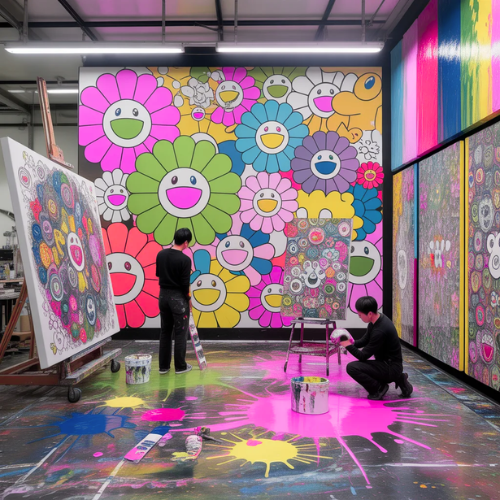
His iconic smiling flowers are a perfect example. At first glance they appear decorative and cheerful, but when displayed in large-scale installations or massive canvases, they create a hypnotic effect. The repetition of forms, the precise symmetry, and the almost mechanical perfection of the composition reflect Murakami’s meticulous approach to visual structure.
This combination of playful imagery and conceptual depth quickly became his signature.
Understanding the “Superflat” Philosophy
One cannot truly understand Murakami without discussing the theory he introduced known as Superflat. The concept emerged in the late 1990s and became one of the defining frameworks behind his artistic practice.
Superflat describes both a visual style and a cultural critique. On the surface level, the term refers to the flatness seen in many traditional Japanese art forms, such as ukiyo-e prints. These artworks often avoid perspective and instead emphasize bold outlines and two-dimensional composition.
Murakami observed that modern anime and manga share similar visual characteristics. The connection between historical Japanese art and contemporary pop imagery fascinated him, and he began exploring how both traditions could coexist within a single aesthetic philosophy.
However, Superflat also carries a deeper meaning. Murakami argues that modern culture has flattened the boundaries between high and low art. Luxury goods, cartoons, fine art, and advertising now exist within the same visual ecosystem.
In practical terms, this means a Murakami painting can appear in a museum exhibition while similar imagery appears on fashion items or commercial products. Rather than seeing this as a contradiction, Murakami sees it as an honest reflection of contemporary culture.
Inside the Studio: Murakami’s Creative Process
Many people imagine artists working alone in quiet studios, slowly painting one canvas at a time. Murakami’s studio environment is quite different. His creative operation functions more like a highly organized workshop or design studio, with teams of assistants collaborating on large-scale projects.
Murakami founded the production company Kaikai Kiki Co., Ltd. to manage this process. The studio handles everything from painting and sculpture fabrication to exhibition planning and artist development. It is an approach that reflects Murakami’s belief that art can exist within a structured production system without losing its conceptual depth.
Despite the size of his studio, Murakami remains deeply involved in the creative decisions behind every piece. Sketches, color studies, and conceptual planning often begin directly with him. Once the design reaches a certain stage, trained assistants help execute the final details under his supervision.
This collaborative process allows Murakami to produce monumental works that would be nearly impossible for a single artist to complete alone. Massive sculptures, expansive murals, and complex installations require both artistic vision and technical coordination.
From my perspective as someone who studies gallery practices closely, Murakami’s studio structure reflects a modern evolution of historical art workshops. Renaissance masters like Leonardo da Vinci also worked with assistants to produce large commissions. Murakami’s method simply adapts that tradition to contemporary scale.
Pop Culture, Anime, and Fine Art Influences
Murakami’s work cannot be separated from the visual language of Japanese pop culture. Anime characters, manga storytelling, and the bright aesthetic of commercial design all feed directly into his artistic vocabulary.
Artists who attempt to incorporate popular culture into fine art sometimes face criticism, but Murakami approaches it with a unique intellectual framework. He does not treat pop imagery as a gimmick. Instead, he views it as an authentic cultural archive that reflects the psychology of modern society.
Consider how anime exaggerates emotion through facial expressions and vibrant color palettes. Murakami amplifies those qualities within his paintings, transforming familiar cartoon-like forms into large-scale compositions that dominate gallery spaces.
At the same time, he studies Western art history carefully. Movements such as Pop Art—popularized by artists like Andy Warhol—demonstrated how everyday imagery could become powerful artistic material.
Murakami takes this concept even further. Instead of simply referencing popular imagery, he builds entire visual universes around it. The result is artwork that feels simultaneously playful, philosophical, and culturally reflective.
For viewers standing in front of a Murakami piece in a gallery setting, the experience can be surprisingly layered. The colors invite immediate attention, the characters feel familiar, and yet the deeper themes slowly emerge the longer one looks.
Collaborations That Expanded His Global Reach
One of the most fascinating aspects of Takashi Murakami’s career is how comfortably he moves between the art world and the broader cultural landscape. Many artists remain confined to galleries and museums, but Murakami intentionally stepped beyond those traditional spaces. His collaborations have allowed his visual language to reach audiences far beyond collectors and art enthusiasts.
A defining example of this approach was his partnership with Marc Jacobs during Jacobs’ tenure at Louis Vuitton. Together, they transformed the classic Louis Vuitton monogram into vibrant, multicolored patterns that featured Murakami’s playful aesthetic. The collaboration blurred the line between luxury fashion and contemporary art, turning handbags into collectible design pieces.
What made this partnership particularly significant was how it challenged traditional art-world boundaries. Some critics initially questioned whether such collaborations diluted artistic credibility. Yet over time, many curators and collectors began recognizing that Murakami was doing something culturally relevant—acknowledging that art, commerce, and design are deeply interconnected in modern society.
Murakami also collaborated with musicians and filmmakers, expanding his visual storytelling into entirely new mediums. His animated work for Kanye West’s album Graduation introduced his colorful universe to millions of music fans around the world. The album cover, featuring a cartoon bear blasting into a surreal dreamlike landscape, became one of the most recognizable visual identities in contemporary music culture.
Through collaborations like these, Murakami has demonstrated that art does not need to remain confined within gallery walls. Instead, it can circulate through fashion, music, design, and digital media while still maintaining conceptual depth.
Themes Behind the Canvas: What His Work Really Explores
While Murakami’s art often appears cheerful and playful, the themes beneath the surface are surprisingly complex. The smiling flowers and vibrant characters that define his work can easily be misinterpreted as purely decorative. In reality, many of his pieces reflect deeper cultural and psychological ideas.
One recurring theme is the relationship between innocence and anxiety in modern society. Murakami frequently explores how childlike imagery can mask more unsettling emotions. The exaggerated smiles seen in his flower motifs sometimes feel almost too perfect, creating a subtle tension between joy and artificiality.
Another important influence is Japan’s cultural history following the World War II. Murakami has spoken about how postwar Japanese society developed a strong fascination with cute or escapist imagery. Characters in anime and manga often present cheerful, exaggerated expressions that provide a kind of emotional refuge from difficult realities.
Murakami integrates this cultural phenomenon into his art. By magnifying those visual elements—sometimes placing them in monumental scale—he encourages viewers to reflect on how entertainment culture shapes collective psychology.
In gallery settings, I often observe viewers initially responding to the color and energy of his work. Yet as they spend more time with the piece, the atmosphere becomes more contemplative. That shift is exactly what Murakami intends: the artwork draws people in through visual charm, then invites deeper reflection.
How Murakami Balances Commercial Success and Fine Art
Few contemporary artists have navigated the intersection of commerce and artistic credibility as effectively as Murakami. While some artists avoid commercial partnerships in order to preserve exclusivity, Murakami openly embraces them.
This philosophy stems directly from his concept of Superflat. According to Murakami, the separation between fine art and consumer culture has largely disappeared in the modern world. Museums, fashion brands, social media platforms, and retail spaces all contribute to the same visual environment.
By acknowledging this reality, Murakami treats commercial collaborations not as compromises but as extensions of his artistic practice. A museum exhibition, a collectible sculpture, and a fashion collaboration can all function as different expressions of the same visual universe.
At the same time, Murakami maintains rigorous control over the quality and conceptual framework of his work. His studio, Kaikai Kiki Co., Ltd., oversees production carefully to ensure that every project reflects his artistic vision.
From a gallery perspective, this balance is particularly fascinating. Murakami’s work proves that an artist can achieve commercial visibility without sacrificing intellectual substance. Instead of diminishing the artwork’s value, his widespread presence often amplifies cultural impact.
Advice Murakami Gives to Emerging Artists
Murakami frequently speaks to younger artists about the importance of understanding both artistic tradition and contemporary culture. His own career demonstrates how these two influences can work together rather than compete.
One piece of advice he often emphasizes is the value of studying art history deeply. While his work may appear modern and playful, Murakami’s knowledge of traditional Japanese painting and Western art movements is extensive. That foundation allows him to experiment confidently while still maintaining intellectual depth.
Another important lesson he shares is the importance of persistence. The contemporary art world can be extremely competitive, and recognition rarely arrives quickly. Murakami spent years developing his ideas before achieving international attention.
He also encourages emerging artists to think globally. In today’s interconnected cultural environment, artists are no longer limited to local audiences. Exhibitions, digital platforms, and cross-disciplinary collaborations allow creative work to travel across borders more easily than ever before.
For artists hoping to build sustainable careers, Murakami’s journey offers a valuable blueprint: combine technical skill, conceptual clarity, and cultural awareness.
The Impact of Murakami on Contemporary Art
Murakami’s influence on contemporary art is difficult to overstate. His work reshaped how many people understand the relationship between fine art and popular culture.
Before Murakami gained international prominence, artists who used cartoon-like imagery or commercial aesthetics were often dismissed as unserious. Today, those visual languages are widely accepted as legitimate artistic tools. Much of that shift can be traced back to Murakami’s success and intellectual framework.
Major institutions such as the Museum of Contemporary Art Los Angeles and the Palace of Versailles have exhibited his work, demonstrating how widely his influence extends across the global art landscape.
Equally important is his role in supporting emerging artists through his studio network and exhibitions. Murakami has actively promoted younger creators, helping them navigate the complex structure of the international art market.
In many ways, Murakami represents a new model for contemporary artists—one that blends creative vision, cultural commentary, and entrepreneurial awareness.
Conclusion
Looking behind the canvas of Murakami’s work reveals an artist who is far more strategic and thoughtful than the bright colors might initially suggest. Every smiling flower, animated character, and saturated background exists within a carefully considered framework about culture, history, and the evolution of art.
From his early academic training to his global collaborations, Murakami consistently challenges assumptions about what art should look like and where it should exist. Museums, fashion houses, music albums, and digital media all become platforms for the same artistic language.
As someone who studies gallery culture closely, I see Murakami’s career as a powerful reminder that art continues to evolve alongside society. The boundaries that once separated artistic disciplines are increasingly fluid, and artists who understand that shift can reach audiences in entirely new ways.
Ultimately, a conversation with Takashi Murakami reveals not just the story of one artist, but a broader narrative about contemporary culture itself. His work reflects a world where art, entertainment, commerce, and technology are constantly intersecting—creating a visual landscape that is vibrant, complex, and unmistakably modern.