In the world of digital art, few names spark as much conversation as Mike Winkelmann. Known globally as Beeple, he has transformed what many people once considered experimental digital work into something that museums, collectors, and serious art investors now pay close attention to. From daily digital creations to record-breaking NFT sales, his journey represents one of the most fascinating shifts in modern art history.
As someone who has spent years observing contemporary artists and gallery trends, I see Beeple’s rise as more than a viral internet story. It represents a major turning point in how art is created, distributed, and collected. Traditional gallery spaces once dominated conversations about artistic legitimacy, but artists like Beeple have expanded that conversation into the digital sphere.
This article explores Beeple’s creative process, the mindset behind his work, and the habits that have allowed him to produce thousands of artworks without missing a single day. By looking closely at how he approaches creativity, digital tools, and artistic discipline, it becomes easier to understand why his work resonates so strongly with both collectors and everyday viewers.
Who Is Beeple? A Quick Look at the Artist Behind the Pixels
Behind the alias Beeple is American digital artist Mike Winkelmann, a creator who has spent nearly two decades producing bold, futuristic visuals that sit somewhere between satire, science fiction, and cultural commentary. Before his name became synonymous with NFTs and record-breaking auctions, he was already widely respected within digital design and motion graphics communities.
Beeple began his career working with 3D graphics, animation, and visual effects. His work often blends surreal landscapes, dystopian technology, political satire, and pop culture references. The result is artwork that feels both humorous and unsettling, often capturing the anxieties and absurdities of modern society.
Many people outside the art world first heard his name during the historic sale of his artwork “Everydays: The First 5000 Days.” The piece sold at Christie’s for an astonishing $69 million, instantly placing Beeple among the most valuable living artists. The sale also sparked widespread conversation about digital ownership, NFTs, and the future of art collecting.
What makes Beeple particularly interesting from an art gallery perspective is that he didn’t follow the traditional path through academic art institutions or gallery representation. Instead, he built an audience online through consistency, experimentation, and a willingness to share his creative journey publicly.
How Beeple Started His Digital Art Journey
Beeple’s path into digital art did not begin with fame, collectors, or million-dollar sales. In fact, it started with curiosity and experimentation. Like many young digital artists, he was fascinated by design software and the endless possibilities of creating images entirely on a computer.
Early in his career, Beeple explored tools like 3D modeling programs and animation platforms. His work during this time was heavily influenced by internet culture, science fiction aesthetics, and graphic design. Rather than focusing on selling art immediately, he concentrated on learning, experimenting, and pushing his technical skills forward.
One of the most important lessons I often highlight to emerging artists in gallery discussions is this: Beeple spent years refining his craft before the world paid attention. His early work was not created for auctions or exhibitions. It was created to practice, explore ideas, and develop a visual language that felt uniquely his own.
This stage of experimentation is often overlooked when people discuss successful artists. Yet it is exactly what allowed Beeple to build the skills necessary to produce complex digital compositions at remarkable speed.
The “Everydays” Project That Changed Everything
The defining moment of Beeple’s career began in 2007 with a simple but incredibly demanding idea. He decided to create and publish a new piece of artwork every single day. This long-running project became known as “Everydays.”
The rules were straightforward but strict. Every day he had to create something new and post it online. No exceptions. No missed days.
At first, the project served as a personal exercise. It forced him to practice daily and improve his technical skills. Over time, however, the project evolved into something far bigger than a simple creative routine.
After years of consistency, the “Everydays” collection became a visual timeline of technological trends, political moments, internet culture, and artistic experimentation. Some images were humorous, others dystopian, and many were visually stunning explorations of futuristic worlds.
Eventually, Beeple compiled the first 5,000 of these daily artworks into the now-famous digital collage Everydays: The First 5000 Days. The work was later auctioned at Christie’s, where it made history by becoming one of the most expensive artworks ever sold by a living artist.
For artists studying his process, the biggest takeaway is not the price tag. It is the discipline behind the project. Producing thousands of artworks over more than a decade demonstrates a level of commitment that few artists manage to sustain.
Beeple’s Creative Process: From Idea to Final Artwork
One of the questions I hear most often from aspiring artists is simple: How does Beeple actually create his work?
His process blends technical skill with spontaneous creativity. While many artists rely heavily on long planning phases, Beeple often works quickly, allowing ideas to evolve while he builds the composition.
A typical creative process for Beeple often involves several stages:
Idea exploration
He begins with a loose concept, often inspired by current events, internet culture, politics, or science fiction themes. Sometimes the idea starts with a visual joke or exaggerated scenario that reflects something happening in the world.
3D scene creation
Using digital tools, he constructs environments, characters, and objects. These scenes may include futuristic cities, giant robotic figures, or surreal landscapes that feel almost cinematic.
Lighting and composition
Like a photographer setting up a studio shot, Beeple carefully adjusts lighting, perspective, and camera angles. This stage dramatically shapes the emotional tone of the artwork.
Final rendering and detail work
After the scene is complete, he refines textures, colors, and visual effects before rendering the final image.
What makes his process particularly fascinating is speed. Because he has practiced daily for years, he can move from concept to finished artwork remarkably quickly compared to many digital artists.
Tools, Software, and Techniques Beeple Uses
Beeple’s creative process relies heavily on modern digital tools, but the software itself is only part of the story. The real strength lies in how he combines these tools to produce visually striking scenes.
Some of the tools commonly associated with his workflow include programs like Cinema 4D and Octane Render. These platforms allow him to build complex 3D environments and render them with realistic lighting and textures.
He also incorporates motion graphics techniques, digital sculpting, and compositing tools to refine his visuals. The ability to move seamlessly between these techniques gives his artwork a polished, cinematic quality that feels almost like a still frame from a futuristic film.
However, tools alone do not create compelling art. Many artists have access to the same software but produce very different results. What makes Beeple’s work stand out is his willingness to experiment constantly and push visual boundaries.
For example, one piece might depict a massive astronaut wandering through a desert of discarded technology. Another might show surreal political figures placed inside exaggerated futuristic environments. These imaginative combinations keep his portfolio unpredictable and visually engaging.
More importantly, Beeple never waits for perfection before publishing. The discipline of completing work daily forces him to prioritize progress over perfection, a mindset that many successful artists quietly share.
When artists ask me what they can learn from Beeple’s approach, I often emphasize this principle: consistent creative output matters more than occasional bursts of inspiration.
Finding Inspiration: Where Beeple Gets His Ideas
One of the most fascinating aspects of Beeple’s work is the wide range of influences that shape each piece. His artwork rarely exists in isolation from the world. Instead, it reflects the constant flow of news, technology, politics, internet culture, and human behavior. As someone who studies artists and their processes closely, I often see Beeple’s work as a visual commentary on modern life rather than simply digital illustration.
Many of his ideas come directly from current events. Political moments, viral internet trends, corporate power, social media culture, and technological advancements frequently appear in exaggerated or satirical forms within his images. By transforming real-world topics into surreal digital scenes, Beeple creates artwork that feels timely and culturally relevant.
Another key source of inspiration is science fiction. Massive futuristic cities, robots, astronauts, and dystopian landscapes appear frequently throughout his portfolio. These visuals reflect long-standing sci-fi traditions but are filtered through Beeple’s own unique sense of humor and satire.
For example, a Beeple artwork might feature a giant robot towering over a modern city, surrounded by corporate logos and pop culture icons. The image may look playful at first glance, but underneath it often carries a deeper commentary about technology, capitalism, or digital culture.
What stands out to me as an art professional is that Beeple does not separate art from everyday life. Instead, he absorbs the world around him and translates it into visual storytelling. That habit allows his work to remain fresh even after thousands of creations.
A Look Behind the Scenes of Beeple’s Daily Workflow
Maintaining the “Everydays” project for more than a decade required an extraordinary level of discipline. For most artists, creating a single artwork can take days or even weeks. Beeple, however, trained himself to move through the creative process quickly while still producing visually compelling results.
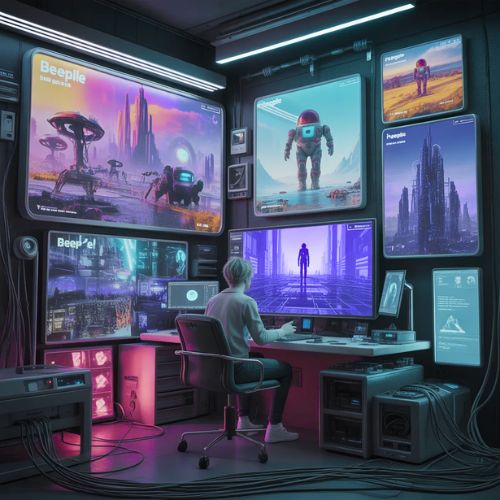
A typical day for Mike Winkelmann often begins with scanning current news, social media trends, or technological developments. These sources frequently spark the conceptual foundation for the day’s artwork.
Once he has an idea, the production phase begins. Beeple moves into his 3D software environment and begins constructing a scene. Because he has worked with digital tools for many years, he can assemble complex environments quickly, using pre-built assets alongside newly created models.
The workflow generally includes:
Concept sketch or idea exploration
3D modeling of characters and environments
Lighting setup to establish mood and depth
Camera placement for cinematic composition
Final rendering and adjustments
What makes his workflow unique is the time pressure he places on himself. Since the artwork must be completed that same day, he cannot spend endless hours perfecting small details. Instead, he focuses on strong visual storytelling and clear composition.
This approach is actually very similar to how many professional illustrators and editorial artists work. The deadline becomes part of the creative engine rather than an obstacle.
Beeple on NFTs and the Future of Digital Art
No discussion of Beeple would be complete without addressing the topic that propelled him into global headlines: NFTs.
The historic sale of Everydays: The First 5000 Days through Christie’s marked a turning point for digital art. For the first time, a purely digital artwork achieved a price that rivaled masterpieces traditionally associated with painting or sculpture.
NFTs, or non-fungible tokens, allow digital artworks to be authenticated and owned through blockchain technology. For artists working in digital mediums, this solved a long-standing problem: how to sell and prove ownership of work that exists entirely online.
Beeple has often spoken about how NFTs opened a new door for digital creators who had previously struggled to find recognition in traditional art spaces. Many galleries historically focused on physical objects such as paintings, sculptures, or prints.
Now, digital artists have new opportunities to reach collectors around the world. Platforms built on blockchain technology allow artists to sell work directly to buyers without relying entirely on gallery systems.
From a gallery perspective, this shift is incredibly significant. Institutions are slowly adapting to a world where digital art holds equal cultural value to traditional mediums. Beeple’s success helped accelerate that transition.
Lessons Artists Can Learn From Beeple’s Creative Discipline
When emerging artists ask what they should learn from Beeple’s journey, I rarely point to his NFT sale first. Instead, I highlight the habits that built his career long before the headlines appeared.
One of the most important lessons is consistency. The “Everydays” project demonstrates that regular creative practice can lead to extraordinary long-term results. Thousands of artworks allowed Beeple to experiment freely while gradually refining his style.
Another lesson involves embracing experimentation. Beeple’s portfolio includes humorous pieces, dystopian imagery, surreal characters, and political satire. Not every artwork needs to be perfect. What matters is the willingness to explore new ideas.
Artists studying his approach might consider adopting habits such as:
Creating regularly instead of waiting for inspiration
Experimenting with new tools and techniques
Sharing work publicly to build an audience
Treating mistakes as part of the creative process
Over time, these habits build technical skill, confidence, and a recognizable artistic voice.
How Beeple’s Work Is Influencing Modern Art and Digital Culture
Today, Beeple’s influence extends far beyond his own artwork. His success has helped legitimize digital art within both the gallery world and the broader cultural conversation.
Before the rise of NFTs, many collectors and institutions were hesitant to treat digital works as serious investments. Now, museums, auction houses, and private collectors are increasingly exploring digital mediums.
Artists working in 3D design, animation, generative art, and virtual reality are finding new audiences. Beeple helped demonstrate that digital creativity can carry the same cultural weight as traditional mediums.
His work has also influenced younger artists who grew up surrounded by internet culture. Memes, video games, social media aesthetics, and sci-fi imagery now appear more frequently in contemporary art discussions.
From my perspective as someone who studies gallery trends, Beeple represents a bridge between traditional art institutions and the rapidly evolving digital landscape.
Key Takeaways From Talking Art With Beeple
After studying Beeple’s creative process and career trajectory, several important insights stand out.
First, long-term dedication matters more than sudden viral success. Beeple spent more than a decade producing daily work before achieving global recognition.
Second, creativity thrives under constraints. The daily deadline forced him to focus on ideas and storytelling rather than perfection.
Third, digital tools are simply instruments. What truly matters is the artist’s vision, imagination, and ability to reflect the world around them.
Finally, Beeple’s story shows that the boundaries of art continue to expand. As technology evolves, new forms of creative expression will continue to emerge.
Conclusion
Looking at the career of Beeple, it becomes clear that his success did not happen overnight. It was built through years of experimentation, consistent practice, and a willingness to push digital art into new territory.
His journey also reveals something deeper about creativity itself. Art is not always about waiting for the perfect idea. More often, it is about showing up every day, creating something new, and allowing the process to guide growth.
For artists, collectors, and art enthusiasts alike, Beeple’s story represents a powerful reminder that innovation often begins with simple habits repeated over time.
In many ways, the true masterpiece of Beeple’s career may not be a single artwork at all. It is the relentless commitment to creating, day after day, and proving that digital art belongs firmly within the future of the art world.