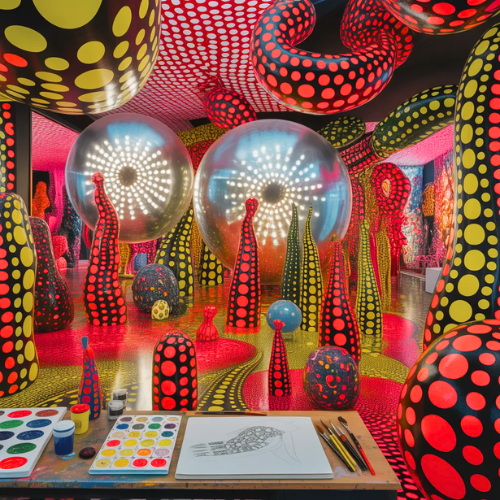
Few contemporary artists have built a visual universe as recognizable and psychologically profound as that of Yayoi Kusama. Walking into one of her exhibitions feels less like visiting a traditional gallery and more like stepping directly into an artist’s mind. Her endless polka dots, mirrored spaces, and immersive installations do more than decorate a room—they transport viewers into an environment shaped by obsession, imagination, and emotional depth.
As someone who has spent years studying gallery practices and contemporary art movements, I’ve noticed that Kusama’s work consistently attracts both seasoned collectors and first-time gallery visitors. Her art manages to balance intellectual complexity with immediate visual impact, which is a rare achievement in the contemporary art world.
This article explores what it truly means to step “inside the creative mind” of Kusama. Rather than simply analyzing her artworks, I’ll look at the philosophy, personal experiences, and studio habits that shape her distinctive artistic voice. Understanding these elements offers a deeper appreciation for why her work resonates across cultures and generations.
Who Is Yayoi Kusama? A Brief Artistic Background
Yayoi Kusama was born in 1929 in Matsumoto, Japan, and her journey into the art world was anything but conventional. Growing up in a conservative environment that discouraged artistic ambitions, she often turned to drawing and painting as a form of emotional escape. Even at a young age, she experienced vivid hallucinations—patterns that appeared to cover objects, surfaces, and even people around her.
These visions later became the foundation of her visual language. The repetitive dots and nets that dominate her artwork are not merely decorative elements; they originate from deeply personal experiences that she has translated into a universal artistic vocabulary.
In the late 1950s, Kusama made a bold decision that changed the trajectory of her career. She moved to New York City, where she entered one of the most dynamic art scenes of the twentieth century. At the time, the city was a hub for avant-garde experimentation, populated by artists pushing the boundaries of painting, sculpture, and performance.
During this period, Kusama developed relationships and rivalries with influential figures such as Andy Warhol and Claes Oldenburg. While her work often intersected with movements like Pop Art and Minimalism, Kusama’s approach remained intensely personal and psychologically driven. Her early installations, particularly her immersive mirror environments, laid the groundwork for the experiential art that has become so popular today.
The Philosophy Behind Kusama’s Creative Vision
To understand Kusama’s art, it’s essential to recognize that her work is rooted in a philosophy she describes as “self-obliteration.” This concept may sound dramatic, but within her artistic framework it represents the dissolution of individual identity into a larger cosmic whole.
In many interviews and writings, Kusama explains that repetition—especially the endless multiplication of dots—is a way of merging the self with the universe. When dots cover every surface, from canvases to rooms to human bodies, the boundaries between objects begin to disappear.
From a gallery perspective, this idea has powerful implications. Instead of simply observing a painting on a wall, visitors become participants within the artwork itself. When stepping into one of her mirror installations, viewers see their reflections multiplied infinitely, reinforcing the feeling that they are part of a larger visual ecosystem.
I often describe Kusama’s philosophy to gallery visitors using a simple comparison. Imagine staring at the night sky and realizing that the stars stretch endlessly beyond what the eye can see. Kusama’s dots function in much the same way—they suggest an infinite universe contained within a single artistic gesture.
This philosophical approach explains why her work resonates far beyond the traditional art audience. It touches on universal themes such as identity, infinity, and the human desire to find meaning within an overwhelming cosmos.
Inside Kusama’s Studio: Where Ideas Become Infinity
Unlike many contemporary artists who rely heavily on teams of assistants, Kusama maintains a deeply personal connection to the act of creating. Even well into her nineties, she continues to work daily from her studio in Tokyo.
The environment of her studio reflects the same visual intensity found in her exhibitions. Large canvases filled with intricate patterns cover the walls, and new sculptures emerge from sketches that often begin as simple dot formations. The space itself functions as both a laboratory and a sanctuary for creative experimentation.
One aspect that fascinates me about Kusama’s studio practice is her discipline. Many artists wait for inspiration to strike, but Kusama approaches art more like a daily ritual. She paints, sketches, and develops ideas consistently, often working for hours at a time.
This dedication highlights an important lesson for emerging artists: creativity is not always spontaneous. In many cases, it is built through repetition, persistence, and the willingness to explore the same idea from multiple angles.
Her studio process also bridges the gap between painting and installation. A pattern that begins on canvas might later evolve into a large-scale sculpture or an immersive room filled with mirrors and lights. This fluid movement between mediums is one of the defining characteristics of her career.
Signature Motifs: Polka Dots, Infinity Nets, and Repetition
If there is one visual element that instantly signals a Kusama artwork, it is the polka dot. However, reducing her work to “dot art” would miss the deeper significance behind these motifs.
The dots represent units of the universe—small individual elements that together form a larger cosmic structure. When repeated endlessly across a surface, they create a rhythm that feels both hypnotic and expansive.
Another recurring element in Kusama’s work is the “Infinity Net.” These paintings consist of thousands of tiny curved strokes layered across massive canvases. At first glance, the surface may appear simple, but closer inspection reveals an almost meditative level of detail.
From a gallery perspective, Infinity Net paintings have a remarkable effect on viewers. Standing close to the canvas, the repetitive marks create a sense of movement, almost like waves rippling across water. The viewer’s eye travels endlessly across the surface without finding a clear beginning or end.
Some of Kusama’s most celebrated installations combine these motifs with reflective materials. Her famous infinity mirror rooms, for example, multiply dots, lights, and reflections into seemingly endless environments. One notable example is her celebrated installation Infinity Mirrored Room—The Souls of Millions of Light Years Away.
These environments illustrate how Kusama transforms simple visual elements into immersive experiences. The dots may begin as small marks on a canvas, but within the context of her installations, they expand into entire universes.
How Personal Experience Shapes Kusama’s Art
To truly understand the work of Yayoi Kusama, it is impossible to separate her art from her personal history. Many of the visual themes that define her career—repetition, infinity, and immersive environments—are rooted in psychological experiences that began in her childhood.
Kusama has spoken openly about experiencing vivid hallucinations from an early age. She described seeing patterns spreading across walls, fabrics, and even people’s bodies. Instead of suppressing these visions, she began translating them into drawings and paintings. In many ways, art became both a coping mechanism and a language through which she could communicate what she was experiencing internally.
From a gallery professional’s perspective, this is one of the reasons her work carries such emotional intensity. Visitors are not simply viewing abstract patterns; they are witnessing a visual interpretation of the artist’s mental landscape. That authenticity gives her work a powerful sense of vulnerability and honesty.
Her personal struggles also shaped one of the most distinctive decisions in her life. In the 1970s, Kusama voluntarily moved into a psychiatric hospital in Tokyo, where she continues to live today. Importantly, this decision did not mark the end of her artistic career. Instead, it coincided with an extraordinary period of productivity.
Each day, she travels from the hospital to her nearby studio, where she continues to paint and design large-scale installations. This routine reflects an incredible commitment to art as both a practice and a form of personal stability. In the contemporary art world, few stories illustrate the healing power of creative expression as clearly as Kusama’s.
The Creative Process: From Concept to Installation
Observing Kusama’s artistic process reveals that her monumental installations often begin with surprisingly simple ideas. A sketch, a pattern, or even a single repeating shape can evolve into an immersive environment that fills an entire gallery space.
Many installations begin with hand-drawn concepts. Kusama frequently sketches dots, organic shapes, or patterns that later develop into sculptures, mirrored environments, or large-scale paintings. This method allows her to explore the rhythm and balance of repetition before committing to a full installation.
What I find particularly fascinating is how her process bridges traditional and contemporary methods. While the final installations may involve advanced lighting systems, mirrored surfaces, and large-scale engineering, the conceptual foundation usually begins with the same tools artists have used for centuries: paper, paint, and imagination.
The development of her infinity rooms offers a perfect example. These installations combine mirrors, lights, and reflective surfaces to create environments that appear to stretch infinitely. When visitors step inside, they become part of the artwork itself.
Some key elements often present in these immersive installations include:
-
Mirrored walls that multiply reflections endlessly
-
Repeating light patterns or suspended objects
-
Carefully controlled lighting that enhances the illusion of depth
The result is an experience that blurs the line between sculpture, architecture, and performance. Visitors are not simply observers—they are participants inside the artwork.
A Studio Conversation: Kusama on Inspiration and Discipline
If there is one misconception about creative genius, it is the belief that inspiration arrives magically. In the case of Yayoi Kusama, inspiration certainly plays a role, but discipline is the true engine behind her longevity.
During studio interviews and public conversations, Kusama often emphasizes the importance of working consistently. She approaches art almost like a daily ritual, returning to her canvases and sculptures with remarkable focus.
From my experience in galleries and artist studios, this level of discipline is what separates prolific artists from those who struggle to maintain momentum. Kusama’s routine demonstrates that creative breakthroughs often come from sustained effort rather than sudden flashes of inspiration.
Another fascinating aspect of her studio conversations is her emphasis on optimism. Despite the psychological struggles that shaped her work, Kusama frequently speaks about creating art that encourages hope, joy, and wonder.
Her brightly colored installations filled with glowing lights often evoke childlike curiosity. When visitors enter these spaces, the experience feels playful, almost magical. This emotional contrast—serious themes expressed through vibrant visuals—is one of the defining qualities of her artistic voice.
The Role of Obsession and Repetition in Her Work
Repetition is not just a visual strategy in Kusama’s work—it is a conceptual foundation. The endless dots, nets, and mirrored reflections are expressions of a deeper artistic obsession with infinity.
In the art world, repetition can sometimes be misunderstood as simplicity. In Kusama’s case, however, repetition is the very mechanism through which complexity emerges. Thousands of tiny marks layered across a surface can create hypnotic movement and visual depth.
From a curatorial standpoint, this repetition also produces a unique viewing experience. The longer someone stands in front of one of her paintings or installations, the more the patterns begin to shift in perception. What initially appears uniform gradually reveals subtle variations.
This effect is particularly powerful in her large-scale environments. When dots cover walls, floors, ceilings, and objects, the viewer’s sense of spatial orientation begins to dissolve. The space feels endless, almost cosmic.
In many ways, this is exactly what Kusama intends. By repeating simple forms indefinitely, she encourages viewers to imagine a universe without boundaries—a space where the individual self dissolves into a larger visual rhythm.
Impact on Contemporary Art and Global Art Culture
The influence of Yayoi Kusama on contemporary art is enormous. Long before immersive exhibitions became popular on social media, Kusama was already creating environments that invited viewers to step directly into the artwork.
Her installations helped redefine the relationship between audience and art object. Instead of standing at a distance, visitors now move through the artwork, experiencing it physically and emotionally.
Major institutions around the world have embraced her work, including exhibitions at museums such as Tate Modern in London and The Museum of Modern Art in New York City.
These exhibitions frequently attract massive audiences, proving that Kusama’s art connects with viewers far beyond traditional gallery circles. Her infinity rooms, in particular, have become cultural phenomena, drawing visitors who may never have previously engaged with contemporary art.
From a professional perspective, her success has also influenced how galleries design exhibitions today. Immersive experiences, interactive installations, and visually striking environments are now common in museums around the world.
What Emerging Artists Can Learn from Kusama’s Approach
For emerging artists, Kusama’s career offers several powerful lessons about creativity and perseverance. Her journey demonstrates that artistic success rarely follows a straight path.
One of the most important lessons is the power of developing a distinct visual language. Kusama’s dots, nets, and mirrored environments are instantly recognizable. This clarity of style has helped her maintain a strong artistic identity across decades of experimentation.
Another lesson is persistence. Kusama faced rejection, financial challenges, and personal struggles throughout her early career. Yet she continued to create art with unwavering determination.
Artists studying her career might consider the following principles:
-
Develop a unique visual signature
-
Commit to daily creative practice
-
Transform personal experiences into artistic expression
-
Embrace experimentation across different mediums
These principles are not limited to visual art. They apply to nearly every creative discipline.
The Enduring Legacy of Yayoi Kusama
At more than nine decades old, Yayoi Kusama remains one of the most influential living artists in the world. Her work continues to attract new generations of viewers, collectors, and scholars.
What makes her legacy particularly remarkable is its combination of emotional depth and visual accessibility. A child encountering her installations for the first time may be drawn to the bright colors and playful patterns, while experienced critics analyze the philosophical ideas behind infinity and self-obliteration.
Few artists manage to bridge that gap between accessibility and conceptual sophistication. Kusama does it effortlessly.
In galleries around the world, her work reminds audiences that art can be both deeply personal and universally meaningful.
Final Thoughts: Understanding the Mind Behind the Masterpieces
Exploring the creative world of Yayoi Kusama reveals more than just a collection of iconic artworks. It reveals a lifelong commitment to transforming personal visions into shared experiences.
Her dots, mirrors, and infinity rooms may appear simple at first glance, yet they embody decades of artistic exploration and emotional honesty. Every installation invites viewers to reflect on their place within a vast and interconnected universe.
From my perspective as someone deeply engaged with gallery culture, Kusama’s work represents one of the most powerful examples of how art can transcend boundaries—between artist and audience, between personal experience and universal meaning.
Stepping into one of her installations is not merely an aesthetic experience. It is an invitation to momentarily see the world through the eyes of an artist who has spent a lifetime exploring the infinite possibilities of imagination.